
Track your progress
To save this lesson to your Academy progress, join the free TradersLink Discord and log in with your Discord account.
Log in with DiscordTrading Risk Management: A Practical Guide
Risk management is how a trader controls what can go wrong.
It is not the exciting part of trading, but it is one of the most important parts. A trader can find good setups and still struggle if losses are too large, size is too big, stops are ignored, or emotions take over after the trade starts moving.
Risk management is not only about using a stop loss.
It includes:
- how much is risked on the trade
- where the trade idea is wrong
- how position size is chosen
- what happens if price moves against the trade
- what happens after a loss
- when the trader should stop trading
- how the risk decision is reviewed later
The goal is not to avoid every loss. Losses are part of trading.
The goal is to keep losses planned, controlled, and reviewable.
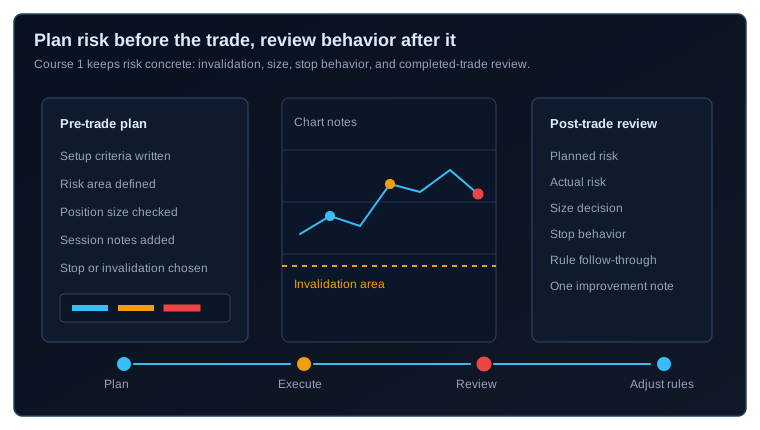
What Risk Management Means
Risk management means deciding how much damage a trade is allowed to do before the trade starts.
A beginner should be able to answer three questions before entering:
- Where is the trade idea wrong?
- How much am I willing to lose if I am wrong?
- What will I do if price reaches that area?
Those questions sound simple, but they are often ignored in live trading.
A stock starts moving. The trader wants to enter. The candle looks strong. The chat is active. The scanner is alerting. Suddenly, risk becomes an afterthought.
That is exactly why risk needs to be planned before the trade.
Risk Is More Than The Stop
A stop loss can be part of risk management, but risk management is bigger than the stop.
A trader can place a stop and still manage risk poorly.
For example:
- the position size may be too large
- the stop may be too far away
- the stock may have poor liquidity
- the spread may be too wide
- the trader may move the stop after entry
- the trader may add to a failing trade
- the trader may keep trading after hitting a daily loss limit
Risk management is the whole process around loss control, not one single order.
Planned Risk Versus Actual Risk
Planned risk is what the trader expected to risk before entry.
Actual risk is what really happened during the trade.
They are not always the same.
A trader may plan to risk $50, then lose $150 because they moved the stop, added after the trade failed, or slipped badly on the exit.
A trader may plan to exit under a level, but hold because they think price will come back.
A trader may size the trade for a tight stop, then widen the stop after entry.
Risk review should compare planned risk with actual risk.
That comparison shows whether the risk plan was followed or rewritten during the trade.
Invalidation
Invalidation means the trade idea is no longer working.
It is the point where the reason for the trade has weakened or failed.
For example:
- a support-bounce idea may be invalid if support breaks and cannot reclaim
- a breakout idea may be invalid if price falls back under the breakout level
- a reclaim idea may be invalid if price loses the reclaimed level again
- a swing trade thesis may weaken if price loses the daily support area
Invalidation is different from simply being down money.
A trade can be red before it is invalid. A trade can also be invalid before the loss becomes large.
The trader needs to know what level or condition changes the idea.
Position Size
Position size is one of the biggest parts of risk management.
A trade that is manageable with small size can become emotional with too much size.
Position size should connect to:
- account risk
- trade risk
- stop distance
- volatility
- liquidity
- spread
- confidence in the setup
- whether the trade is intraday or overnight
The goal is not to take the biggest position possible.
The goal is to take a size that still allows the trader to follow the plan if the trade does not work.
Daily Loss Limits
A daily loss limit is a rule that tells the trader when to stop or reduce activity after losses.
This matters because many traders do the most damage after they are already frustrated.
A daily loss limit can help prevent:
- revenge trading
- oversized recovery attempts
- random trades after a bad start
- emotional rule changes
- turning one bad trade into a bad day
The exact number is personal to the trader’s plan, account, and experience.
The lesson is that risk should have boundaries at the trade level and the session level.
Adding To Losing Trades
Adding to a losing trade is one of the most dangerous beginner habits when it is not planned.
Sometimes traders add because they believe the setup is still valid. Sometimes they add because they want a better average price. Those are not the same thing.
A planned add should be defined before the trade.
An emotional add often happens after the trade is already uncomfortable.
A beginner should ask:
- Was the add part of the plan?
- Did the setup improve or fail?
- Did the add increase risk after invalidation?
- Was the trader trying to fix the average price?
Adding should not be used to avoid admitting the trade idea changed.
Realistic Example
A trader buys a stock after a morning breakout.
Before entry, they decide the idea is wrong if price loses the breakout level and cannot reclaim it.
The trade pulls back to that level.
A risk-managed review would ask:
- Was the invalidation area clear before entry?
- Was the position size built around that risk?
- Did the trader reduce or exit when the level failed?
- Did the trader add after the trade moved against them?
- Did the actual loss match the planned risk?
- Did spread or slippage affect the exit?
The trade outcome matters, but the risk behavior matters more for long-term improvement.
Winning Trades Can Hide Bad Risk
A winning trade is not always a good trade.
A trader can ignore risk, add emotionally, hold through invalidation, and still make money if price later bounces.
The result is green, but the habit may still be dangerous.
This is why risk management should be reviewed on winning trades too.
Ask:
- Did the trade follow the risk plan?
- Did the trader stay within size limits?
- Did the trader respect invalidation?
- Did the trader get bailed out by price action after breaking rules?
A good result should not hide bad risk behavior.
What Beginners Usually Get Wrong
Common risk management mistakes include:
- entering before knowing the risk area
- choosing size before defining invalidation
- sizing too large for the setup
- moving stops because of hope
- adding to losing trades emotionally
- ignoring spread and slippage
- treating low-priced stocks as low-risk stocks
- trading after hitting a loss limit
- judging risk only by final P&L
The biggest problem is usually not one mistake.
It is repeating the same risk mistake without reviewing it.
What To Check Before A Trade
Before taking or studying a trade, check:
- What is the trade idea?
- Where is the idea wrong?
- How much is planned risk?
- What position size fits that risk?
- Is the spread reasonable?
- Is liquidity clean enough?
- What happens if the trade fails quickly?
- What happens after the daily loss limit is reached?
- Is adding allowed, and under what condition?
These questions make risk part of the setup instead of an afterthought.
How This Helps When Studying Trades
When looking back at a trade, review risk as its own category.
Ask:
- Did the trader know the risk before entry?
- Was position size appropriate?
- Was invalidation respected?
- Did planned risk match actual risk?
- Did the trader add after the trade failed?
- Did the trader keep trading after they should have stopped?
- Was the loss controlled or avoidably large?
- Did the same risk mistake repeat?
This is how a trader starts seeing risk patterns instead of only trade results.
Key Takeaway
Risk management is the process of controlling how much damage a trade or session can do.
It includes planned risk, invalidation, position size, stops, daily loss limits, adding rules, liquidity, spread, slippage, and review.
The goal is not to avoid losses. The goal is to keep losses controlled and honest.
Related Lessons
- Position Sizing
- Revenge Trading
- Overtrading
- Trade Review And Improvement
FAQ
What is trading risk management?
Trading risk management is the process of controlling potential losses through planned risk, position size, invalidation, stops, daily limits, and review.
Why is risk management important in trading?
Risk management helps keep losses controlled so one trade or one emotional session does not create much larger damage.
Is risk management only about stop losses?
No. Stops are one part. Position size, trade selection, daily limits, adding behavior, liquidity, slippage, and emotional control also matter.
What is planned risk?
Planned risk is the amount the trader expects to risk if the trade idea fails and the trade is managed according to the plan.
What is actual risk?
Actual risk is what really happened in the trade, including slippage, added size, moved stops, and any loss beyond the original plan.
Should winning trades be reviewed for risk?
Yes. Winning trades can still include poor risk behavior, such as oversizing, ignoring invalidation, or adding emotionally.