
Track your progress
To save this lesson to your Academy progress, join the free TradersLink Discord and log in with your Discord account.
Log in with DiscordChart Pattern Basics: How Traders Read Price Structures
Chart patterns are recurring price structures.
They are not magic shapes. They are not something a trader should force onto every chart. A chart pattern is simply a way to describe how price is behaving around levels, ranges, trend, volume, and failed or successful moves.
By this point in the course, you have already studied the pieces that create most patterns:
- Candles
- Support and resistance
- Key levels
- Swing highs and swing lows
- Breakouts and breakdowns
- Reclaims and failed moves
- Compression and consolidation
Chart patterns combine those pieces into recognizable structures.
A bull flag is not just a flag shape. It is a strong move, then a controlled pause. A double top is not just two highs. It is price failing around a similar resistance area. A triangle is not just two trendlines. It is price compressing between tightening highs and lows.
The pattern name is less important than the behavior the pattern is describing.
What A Chart Pattern Is
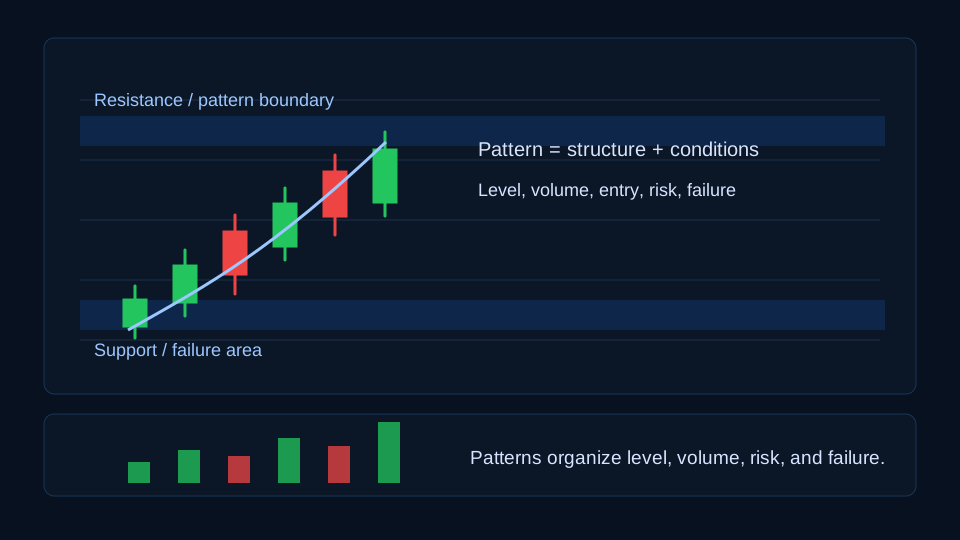
A chart pattern is a structure made from price behavior.
It may include:
- A prior move
- A support area
- A resistance area
- A range
- A tightening structure
- Higher lows or lower highs
- Volume changes
- A breakout, breakdown, reclaim, or failed move
A pattern gives the trader a way to organize the chart.
Instead of saying, “price is moving around,” the trader can say, “price made a strong move, pulled back in a controlled way, and is now testing the top of the range again.”
That description matters more than the label.
Why Patterns Are Useful
Patterns are useful because they group common chart behaviors.
They help traders recognize:
- A pause after a strong move
- Pressure building near a level
- Repeated rejection at resistance
- Repeated support at a base
- A range becoming tighter
- A breakout failing back into the range
- A move becoming too extended
The value is not memorizing names. The value is understanding what the structure is showing.
A beginner who only memorizes names may see patterns everywhere. A beginner who understands structure can tell when the pattern is clean, forced, late, or already failed.
Patterns Are Built From Levels
Most chart patterns begin with levels.
A double top needs a resistance area. A double bottom needs a support area. A rectangle needs a range high and range low. A triangle needs tightening levels. A flag needs a strong move and a controlled pullback.
If the levels are unclear, the pattern is usually unclear too.
Before naming a pattern, ask:
- Where is support?
- Where is resistance?
- What level is price testing?
- What level would show the pattern is failing?
- Was the structure visible before the move?
If those questions are hard to answer, the pattern may be forced.
The Main Pattern Groups
Chart patterns become easier when they are grouped by behavior instead of memorized one by one.
Continuation Patterns
Continuation patterns describe a pause inside a larger move.
Examples include bull flags, bear flags, pennants, cup and handle structures, and base breakouts.
The main idea is that price made a move, paused or pulled back, and traders are watching whether the move can continue.
The pause matters. If price is already extended and there is no controlled pullback or base, the pattern may be less useful.
Compression Patterns
Compression patterns describe price getting tighter.
Examples include ascending triangles, descending triangles, symmetrical triangles, wedges, and narrowing ranges.
The main idea is that price is being squeezed between important areas. The chart may be building pressure, but direction is not known until price resolves the range.
Compression patterns are easy to overread. A tight chart can still fake out or break the opposite way.
Range And Channel Patterns
Range and channel patterns describe price moving between visible boundaries.
Examples include rectangles and channels.
The main idea is that price is respecting a top and bottom area, or moving inside a sloped path.
These patterns are useful only when the boundaries are clear. If every candle is messy and overlapping, the pattern may only be chop.
Reversal And Exhaustion Patterns
Reversal and exhaustion patterns describe a move losing control or changing character.
Examples include double tops, double bottoms, triple tops, triple bottoms, head and shoulders, inverse head and shoulders, rounding tops, rounding bottoms, and parabolic moves.
The main idea is that the prior move may be weakening or shifting.
These are some of the easiest patterns to see too early. A trader may call a reversal before price has actually changed structure.
Failure And Reclaim Patterns
Failure and reclaim patterns focus on what happens after a level appears to break.
Examples include failed breakouts, failed breakdowns, and VWAP reclaims.
The main idea is that the first move did not hold. Price tried to move through a level, failed, reclaimed, or rejected.
These patterns are useful because they train the trader to watch the reaction after the first move, not just the first candle.
Clean Patterns Versus Forced Patterns
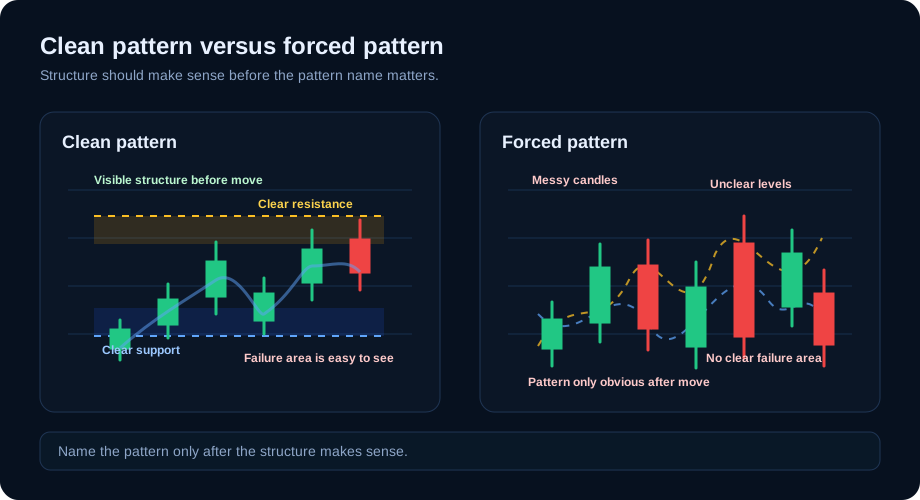
A clean pattern is easy to explain.
The levels are clear. The structure is visible before the move. The pattern has a clear area that would prove it wrong. The chart behavior matches the idea without needing too much imagination.
A forced pattern is different.
A forced pattern usually appears after the move. The trader looks backward and finds a name that makes the trade look better. The levels are unclear. The shape only works if the chart is zoomed or stretched in a certain way. The failure area is vague.
A clean pattern helps the trader understand the chart.
A forced pattern gives the trader a story.
That difference matters.
Context Still Matters
A pattern should not be read by shape alone.
The same shape can mean different things depending on location.
A bull flag into a major resistance area is different from a bull flag with room above. A double bottom near real support is different from two random lows in the middle of chop. A triangle after a strong move is different from a triangle inside a dead range with no volume.
Before trusting a pattern, look at:
- The level being tested
- The trend before the pattern
- Volume behavior
- Liquidity and spread
- Nearby support or resistance
- The failure area
- The timeframe
- Whether the pattern was visible before the trade
The name is only useful after the structure makes sense.
Realistic Example
A stock runs after news, pulls back, and then starts holding higher lows under high of day.
One trader may call it a bull flag. Another may call it an ascending triangle. Another may simply say price is building under resistance.
The label debate is not the most important part.
The better questions are:
- Was there a strong move first?
- Did the pullback stay controlled?
- Was resistance clear?
- Were higher lows forming under the level?
- Did volume support the break?
- Where would the structure fail?
If those answers are clear, the trader understands the setup even if the exact pattern name is debatable.
How To Use The Deep-Dive Lessons
The next page organizes the focused chart-pattern lessons by group.
You do not need to memorize every pattern before continuing the core course.
Use the deep-dive lessons when a specific pattern appears on a chart or when you want to study one type of structure more closely.
The pattern lessons include:
- Continuation patterns such as flags, pennants, cup and handle, and base breakouts
- Triangle and compression patterns such as ascending, descending, and symmetrical triangles
- Range and channel patterns such as rectangles and channels
- Reversal and exhaustion patterns such as double tops, double bottoms, head and shoulders, and rounding structures
- Failure and reclaim patterns such as failed breakouts, failed breakdowns, and VWAP reclaim
Think of the deep-dive section as a pattern library, not a test you must complete before moving forward.
What Beginners Usually Get Wrong
The biggest mistake is learning pattern names before learning structure.
When that happens, the trader starts seeing patterns everywhere.
Common mistakes include:
- Forcing a pattern onto messy price action
- Ignoring support and resistance
- Ignoring volume
- Ignoring where the pattern formed
- Entering after the pattern already played out
- Treating the pattern name as a full trade plan
- Ignoring the failure area
- Drawing the pattern only after the trade is over
- Arguing over the label instead of reading the behavior
A pattern should make the chart easier to understand. If the pattern name makes the chart more confusing, go back to levels, range, volume, and structure.
What To Watch Before Naming A Pattern
Before naming a chart pattern, ask:
- What move came before it?
- Where is support?
- Where is resistance?
- Is the range clear or messy?
- Is price compressing, consolidating, rejecting, or reclaiming?
- Is volume helping the read?
- What level would make the pattern fail?
- Was this visible before the move?
If those questions are clear, the pattern name can be useful.
If those questions are not clear, the pattern name may only be decoration.
How This Helps When Studying Charts Or Trades
Chart patterns help traders study whether a trade came from real structure or a label added after the fact.
When looking back at a chart or completed trade, ask:
- Was the pattern visible before the decision?
- Were the levels clear?
- Was the pattern clean or forced?
- Did volume match the idea?
- Did price confirm, fail, or reclaim the key level?
- Did the trader enter near structure or late after the move?
- Was the pattern name useful, or did it distract from the actual price behavior?
This keeps patterns practical. The point is not to memorize shapes. The point is to understand what price was doing.
Key Takeaway
Chart patterns are price structures built from levels, ranges, trend, candles, volume, and failed or successful reactions.
The pattern name matters less than the behavior behind it. Learn the structure first. Use the pattern name second.
Do not force the shape. Read the chart.
Related Lessons
- Chart Pattern Deep-Dive Lessons
- Bull Flag Pattern
- Bear Flag Pattern
- Cup and Handle
- Ascending Triangle
- Descending Triangle
- Symmetrical Triangle
- Double Top
- Double Bottom
- Head And Shoulders Pattern
- Failed Breakout Pattern
- Failed Breakdown Pattern
- Support And Resistance
- Compression
- Consolidation
- Volume
FAQ
What are chart patterns?
Chart patterns are recurring price structures traders use to organize behavior around levels, ranges, trend, volume, and failed or successful reactions.
Do chart patterns always work?
No. Patterns can break, fail, fake out, or become chop.
What matters more than the pattern name?
Support, resistance, trend, volume, location, timeframe, and the failure area usually matter more than the name.
Should beginners memorize every chart pattern?
No. Beginners should first learn the structure behind patterns, then use individual pattern names as shortcuts later.
Can two traders name the same pattern differently?
Yes. One trader may call a structure a bull flag while another calls it an ascending triangle. The behavior matters more than the label debate.
What should beginners check before naming a pattern?
Beginners should check the prior move, support, resistance, range quality, volume, location, and what would make the pattern fail.