
Track your progress
To save this lesson to your Academy progress, join the free TradersLink Discord and log in with your Discord account.
Log in with DiscordBull Pennant
Best suited for: day trading and momentum swing trading.
A bull pennant forms after a strong upward move when price compresses into a small tightening range. It is related to a bull flag, but the pause is usually tighter and more triangular.
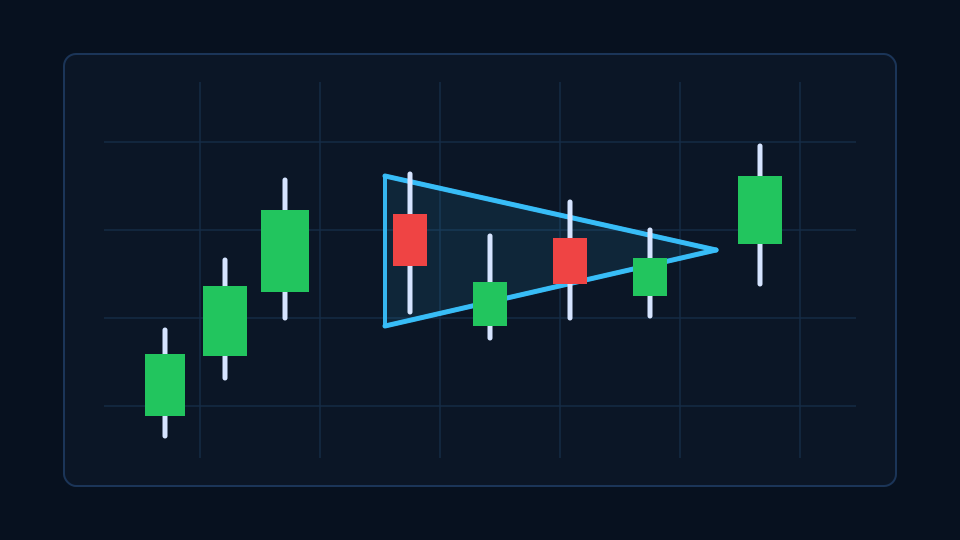
What The Structure Looks Like
A bull pennant usually has:
- A strong first move upward.
- A small tightening range after that move.
- Lower highs and higher lows inside the pennant.
- Volume that often cools during compression.
- A clear lower boundary where the read weakens.
What It Usually Represents
The pattern usually represents a pause after momentum. It can show that price is compressing instead of giving back the full move.
Where Traders Force It
Traders force bull pennants when they draw tiny triangles after any green candle, ignore extension, or enter after the pattern has already expanded.
A clean pennant should be visible without zooming into a few random candles.
What Confirms Or Weakens It
The read strengthens when the first move had participation, the pennant stays tight, and volume supports the next test.
The read weakens when the range gets wide, the lower boundary fails, or price is already too extended from nearby support.
How It Fails
A bull pennant fails when compression breaks down, price loses the lower boundary, or an attempted move out of the pennant falls back inside.
How To Review It After The Trade
Review whether the first move and compression were clean before the decision.
- Was the first move strong enough to matter?
- Did the pennant compress or simply chop?
- Did volume support the next test?
- Where did the structure fail?
- Was the entry late relative to the pennant?
Related Lessons
- Bull Flag Pattern
- Symmetrical Triangle Pattern
- Compression
- Volume
- Chasing Stocks
Key Takeaway
A bull pennant is momentum plus tight compression. It is useful only when the first move, range, volume, and failure area are clear.