
Track your progress
To save this lesson to your Academy progress, join the free TradersLink Discord and log in with your Discord account.
Log in with DiscordVWAP Reclaim
Best suited for: intraday trading.
A VWAP reclaim happens when price moves back above VWAP after trading below it. Traders often watch this because VWAP can act as an intraday reference area for average price, participation, and session control.
A VWAP reclaim still needs follow-through. Price can reclaim VWAP, fail, and move back below it quickly. The reclaim matters only if the price action, volume, and context support the idea.
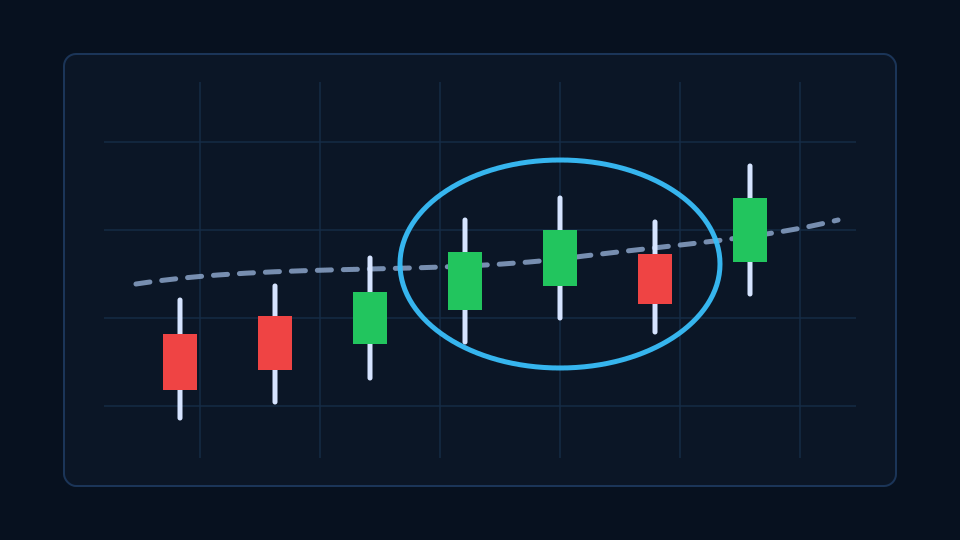
What It Is
A VWAP reclaim is a move back above VWAP after price was previously trading below it.
- Price starts below VWAP.
- Price pushes back toward VWAP.
- Price moves above VWAP.
- Traders watch whether VWAP holds after the reclaim.
- Price may continue, chop, or fail back below VWAP.
The key is not the line by itself. The key is behavior after the reclaim.
What It Measures
A VWAP reclaim uses VWAP as an intraday average-price reference. It measures how price behaves around that reference, not a complete read by itself.
VWAP itself is a volume weighted average price calculation, and platform values can vary based on session definition, data feed, tick-versus-bar calculation, and whether extended-hours data is included. A reclaim is therefore a review of price behavior around a charting reference, not a complete trading plan by itself.
How Traders Use It As Context
Traders may review a VWAP reclaim by checking:
- Whether price was clearly below VWAP first.
- Whether the reclaim had volume.
- Whether VWAP held after the reclaim.
- Whether nearby resistance limited the move.
- Whether there was a catalyst or relative volume.
- Whether the entry happened before or after extension.
VWAP is only one level. Support, resistance, volume, liquidity, and news still matter.
When It Can Mislead
VWAP reclaims can mislead when traders enter late after a large reclaim candle, ignore resistance, or assume price above VWAP is safe. Failed reclaims can trap traders who had no invalidation plan.
Example Chart Read
A stock sells off after the open, bases below VWAP, then reclaims VWAP with stronger volume. Price pulls back to VWAP and holds while resistance is still above.
That is a structured reclaim to review. A different stock spikes above VWAP on one candle, runs directly into resistance, and fails back below VWAP. That is a failed reclaim to review, a failed reclaim to review around the level.
Common Mistakes
One common mistake is treating any quick move back above VWAP as a complete plan.
Another mistake is chasing after a large reclaim candle.
Traders also make mistakes when they ignore nearby resistance.
Another mistake is entering a reclaim with no invalidation level.
A final mistake is holding after VWAP is lost again even though the reclaim idea failed.
Related Lessons
- VWAP
- Level Reclaim
- Volume
- Chasing Stocks
- Execution Review
Key Takeaway
A VWAP reclaim is a tool-based reclaim context, not a classic chart pattern. Review whether price reclaimed VWAP with structure or only crossed it briefly.
FAQ
What is a VWAP reclaim?
A VWAP reclaim happens when price moves back above VWAP after previously trading below it.
Is VWAP reclaim bullish?
It can be constructive context for some traders, but it still needs follow-through.
What makes a VWAP reclaim stronger?
Traders often review volume, follow-through, whether VWAP holds, and whether resistance is nearby.
Can VWAP reclaim trades fail?
Yes. Price can move above VWAP, reject, and lose the level again.
Why does volume matter?
Volume can show participation around the reclaim, but it still needs follow-through.
How should VWAP reclaim trades be reviewed?
Review reclaim quality, entry timing, volume, VWAP hold or failure, nearby levels, and risk control.