
Track your progress
To save this lesson to your Academy progress, join the free TradersLink Discord and log in with your Discord account.
Log in with DiscordBase Breakout
Best suited for: day trading and swing trading.
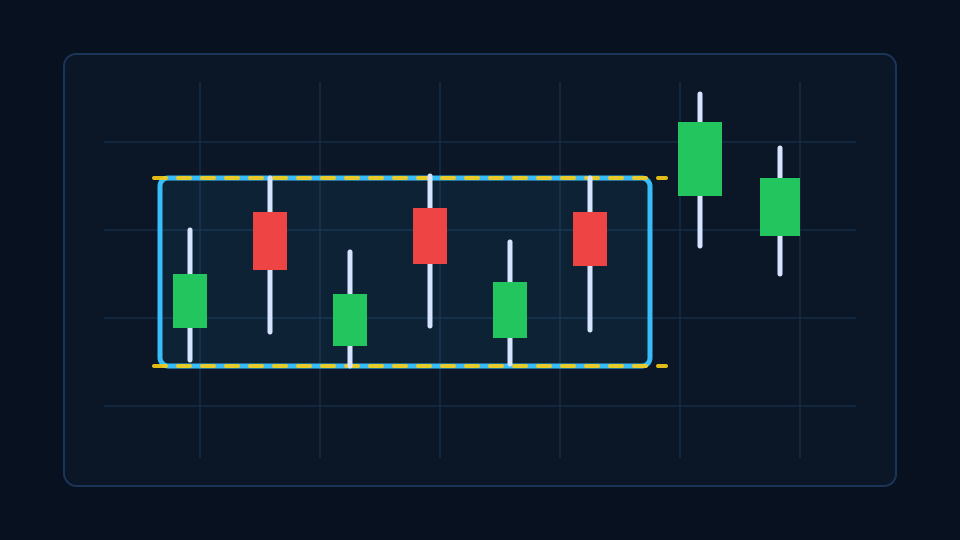
A base breakout forms when price spends time building a sideways range and then moves above the top of that range. The base matters because it gives the breakout a clear level to work from.
A cleaner base breakout has a visible range high, enough time spent building the base, and a break that holds instead of snapping right back inside.
What It Is
A base breakout forms when price moves out of a sideways base or consolidation range.
- A sideways base or consolidation.
- Clearly visible range high.
- Volume and participation review.
- Break above the range or failure back inside.
- Retest or hold behavior after the break.
Review the base quality, the range high, the volume on the break, and whether price held the breakout area afterward.
Pattern Structure
The pattern shows price leaving a base, but the break still needs follow-through.
- A sideways base or consolidation.
- Clearly visible range high.
- Volume and participation review.
- Break above the range or failure back inside.
- Retest or hold behavior after the break.
Context That Matters
The strongest reads come from a clean base that was visible before the breakout, not from a range drawn after price already moved.
- Support and resistance quality.
- Trend before the pattern.
- Volume during formation and attempted break.
- Distance from invalidation.
- Liquidity, spread, and slippage.
- Catalyst, filing, or market context where relevant.
When It Can Mislead
Base breakouts mislead when traders ignore how far price already moved before entry or when the break has no volume.
Example Chart Read
A stock spends several sessions in a tight range, then moves above the range high with volume. Review focuses on whether it held the breakout area or failed back into the base.
Common Mistakes
One common mistake is seeing the pattern before it is actually formed.
Another mistake is entering late after the clean risk area has passed.
Traders also make mistakes when they ignore volume and nearby levels.
Another mistake is holding after the pattern fails.
A final mistake is using the pattern label to justify a reactive trade.
Related Lessons
- Rectangle Pattern
- Symmetrical Triangle Pattern
- Consolidation
- Level Breakout
- Volume
- Failed Breakout Pattern
Key Takeaway
A base breakout should show a real base and a clear level. If the base was labeled only after price moved, the review should treat it as a late read.
FAQ
What is Base Breakout?
A base breakout forms when price moves out of a sideways base or consolidation range.
What weakens a base breakout?
It weakens if price breaks above the range and quickly falls back inside the base, especially when volume fades.
What context matters most?
Levels, trend, volume, liquidity, risk, and follow-through matter most.
Why do these trades fail?
They often fail because entries are late, volume fades, a key level fails, or the pattern was forced.
How should it be reviewed?
Review pattern quality, entry timing, volume, level behavior, invalidation, and whether the plan was followed.
What should this pattern be compared with?
Compare it with the base length, the range high, volume, and whether the first pullback respects the breakout area.