
Track your progress
To save this lesson to your Academy progress, join the free TradersLink Discord and log in with your Discord account.
Log in with DiscordHow to Draw Support and Resistance Without Cluttering Your Chart
Drawing support and resistance is not about finding every possible line on a chart.
It is about finding the few price areas that actually help you understand the trade location.
A beginner can usually find dozens of highs, lows, wicks, and tiny reactions. The problem is that too many levels make the chart harder to read, not easier. A good level should simplify the chart. It should help you see where price has reacted, where it may run into trouble, and where the trade idea starts to weaken.
The goal of this lesson is simple:
Mark the levels that matter, ignore the ones that do not, and keep the chart clean enough to make decisions.
Before You Draw Levels
Before drawing support and resistance, remember what a level is supposed to do.
A useful level should help answer at least one of these questions:
- Where has price reacted before?
- Where is the nearest support below price?
- Where is the nearest resistance above price?
- Where would the trade idea start to fail?
- Is the stock moving into a good location or a poor location?
- Is the level close enough to matter right now?
If a level does not help with any of those questions, it may not belong on the active chart.
This is where many new traders get stuck. They think more lines mean more analysis. Usually, more lines just mean more noise.
Step 1: Start With Zones, Not Exact Lines
The first rule is to stop trying to make every level penny perfect.
Real charts are messy. Price may react a little above or below the same area. One candle may wick through the level. Another may close just under it. A third may hold the body but not the wick.
That does not always mean the level is wrong. It may mean the level is better understood as a zone.
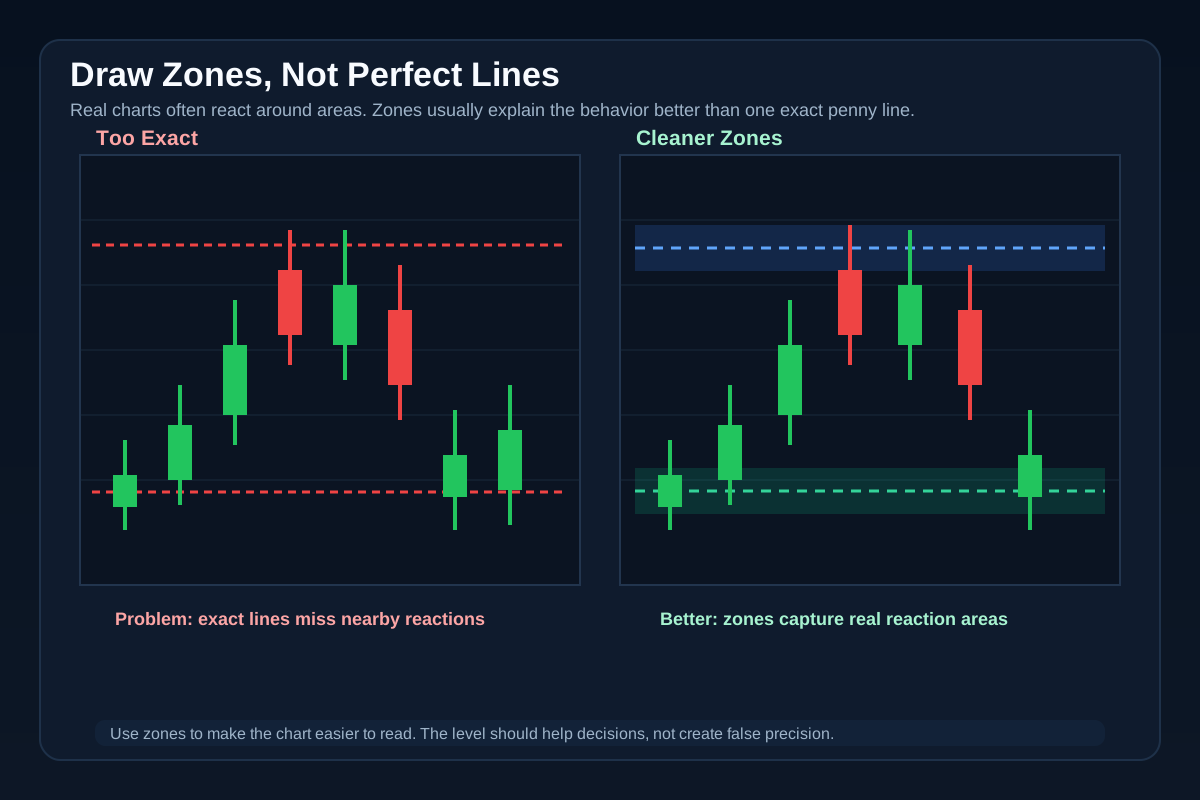
A support zone might include several lows that formed near each other. A resistance zone might include several highs or rejections in the same area.
A clean zone is wide enough to capture real price behavior, but not so wide that it becomes useless.
For example, if a stock keeps bouncing between $2.48 and $2.52, a beginner does not need to fight over whether support is exactly $2.48, $2.50, or $2.52. It may be cleaner to think of that area as a support zone near $2.50.
Step 2: Mark The Obvious Reactions First
The best levels usually stand out quickly.
Start by looking for areas where price clearly did something:
- Bounced
- Rejected
- Consolidated
- Broke out
- Broke down
- Reclaimed
- Failed
- Formed a major swing high or swing low
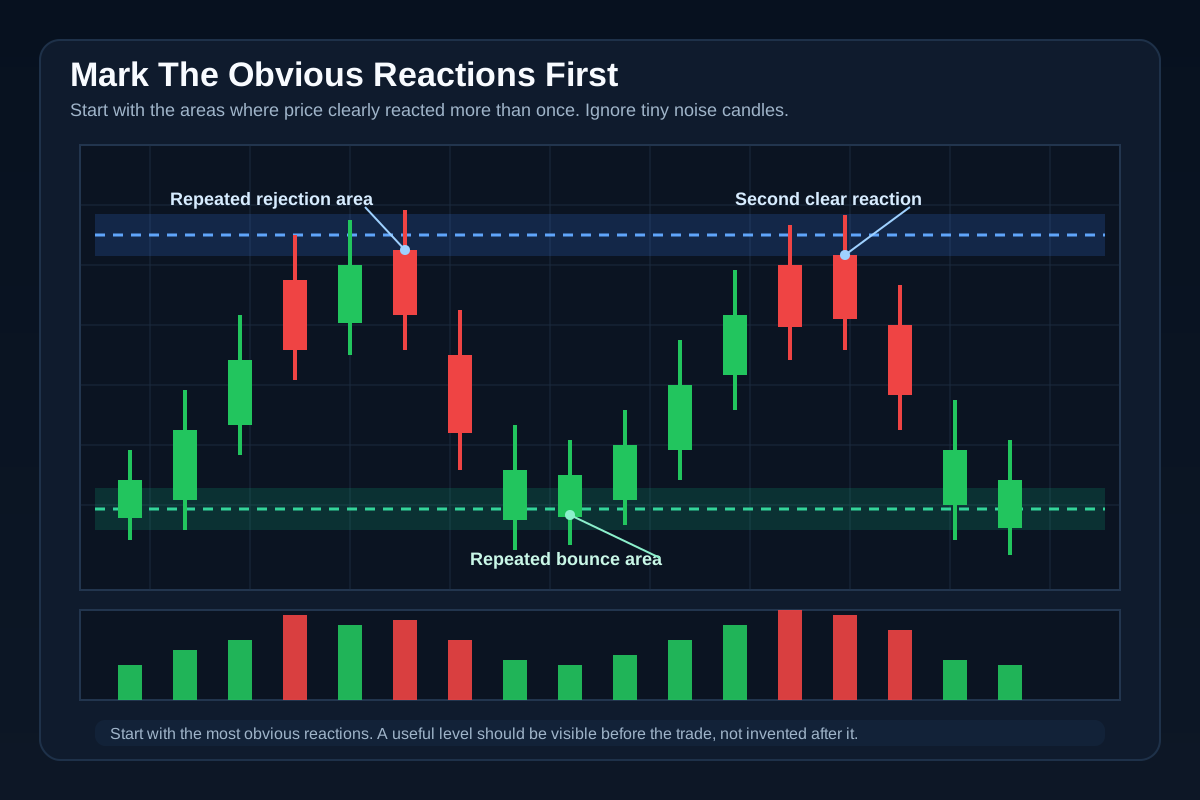
Do not start with every tiny candle. Start with the areas that changed the chart.
A useful reaction area might be a place where price rejected hard, bounced with volume, based for a while, or failed after trying to break through. If you have to zoom in deeply and argue with yourself to see the level, it is probably not one of the main levels.
A good beginner rule:
Mark the levels that would still look important if you stepped back from the screen.
Step 3: Check The Bigger Timeframe
The bigger timeframe helps you avoid getting trapped in tiny intraday noise.
If you are day trading, you may still want to check the daily chart first. A daily resistance area can matter even if the intraday chart looks strong. A previous day high or premarket high can also matter because many traders watch those areas.
For day trading, common larger or session-based levels include:
- Previous day high
- Previous day low
- Premarket high
- Premarket low
- Daily chart support
- Daily chart resistance
- Major high of day or low of day
- Clear intraday swing highs and lows
For swing trading, the higher timeframe matters even more. Swing traders often care about daily and multi-day levels because the trade is meant to play out over more than one session.
For swing trading, useful levels may include:
- Daily support and resistance
- Multi-day highs and lows
- Prior breakout zones
- Prior breakdown zones
- Gap areas
- Larger consolidation ranges
- Weekly chart reaction areas
The point is not to make the chart more complicated. The point is to make sure you are not ignoring a level that matters just because it is not obvious on the smaller timeframe.
Step 4: Keep The Levels Near The Current Plan
A chart can have many historical levels. You do not need all of them on the active chart.
For the current trade idea, the most useful levels are usually:
- The closest support below price
- The closest resistance above price
- The level that would weaken or invalidate the idea
- The next major trouble area
- A major premarket, previous day, or daily level nearby
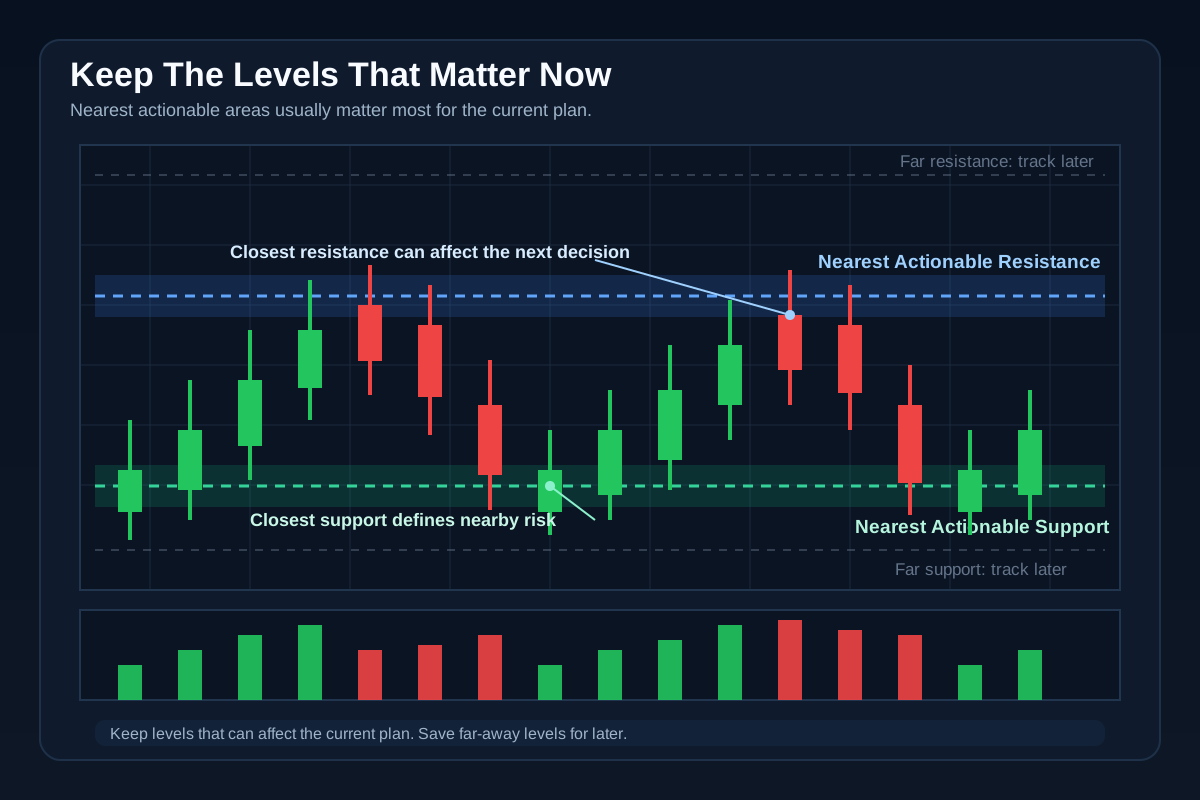
Far-away levels can still matter later. But if price is trading at $2.80, a level at $6.50 probably does not need to be on the active intraday decision chart unless there is a specific reason.
The active chart should answer what matters now.
Step 5: Remove Clutter
After marking levels, the next step is removing levels.
That sounds strange, but it is one of the most important parts of chart reading.
Look at each level and ask:
- Does this level affect the current trade idea?
- Is this level more important than the levels around it?
- Did price react there clearly?
- Is this level too far from current price?
- Is this level helping me or distracting me?
If a level does not help, remove it.
A clean chart often has fewer levels than a beginner expects. That is a good thing. The trader should be able to look at the chart and quickly understand the nearest support, nearest resistance, and the area where the trade idea changes.
A Simple Level-Drawing Process
Here is a practical process a beginner can follow:
- Start with the bigger timeframe.
- Mark the most obvious highs and lows.
- Look for repeated reactions around the same area.
- Treat levels as zones, not exact lines.
- Add important premarket or previous day levels if you are day trading.
- Keep the levels closest to the current trade plan.
- Remove levels that create clutter.
- After the move, check whether the levels actually helped explain the chart.
This process gives you a clean map instead of a chart full of random lines.
Realistic Example
A stock is trading around $2.80 in premarket.
You look at the chart and notice:
- Yesterday’s high was near $3.05.
- Premarket high is $2.92.
- Premarket low is $2.55.
- Price bounced near $2.60 three times.
- The daily chart has an old reaction high near $3.25.
A clean chart may only need four important zones:
- $2.55 to $2.60 support
- $2.92 premarket resistance
- $3.05 previous day high
- $3.25 daily resistance
That is enough to understand the current area.
If price is sitting at $2.80, the trader can see nearby support below and resistance above. If price moves into $2.92, the trader knows it is testing premarket resistance. If it clears $2.92, the next area may be $3.05. If it loses $2.55 to $2.60, the premarket support area has failed.
The chart does not need every tiny candle high between those zones. Those extra lines may make the chart look more detailed, but they usually make the decision harder.
Clean Example Versus Cluttered Example
A clean level map might show:
- One support zone below price
- One resistance zone above price
- One major higher-timeframe level nearby
- One invalidation area for the trade idea
A cluttered level map might show:
- Every small wick high
- Every small wick low
- Several lines inside the same zone
- Far-away levels that do not affect the current plan
- Lines added after the trade already happened
The clean chart helps the trader think.
The cluttered chart gives the trader too many excuses.
What Beginners Usually Get Wrong
The most common mistake is drawing too much.
Beginners often mark every candle high and low because they do not want to miss anything. But the more lines they add, the less each line means.
Other common mistakes include:
- Drawing exact lines instead of zones
- Ignoring the bigger timeframe
- Keeping levels that are too far away
- Moving levels after entry to justify the trade
- Drawing levels only after seeing the result
- Forgetting premarket levels on gap-up stocks
- Ignoring volume around the level
- Treating all levels as equally important
- Using old levels that no longer affect the current chart
A good level should make the trade location clearer. If it makes the chart more confusing, it is probably not helping.
What To Look For After Price Reaches A Level
Once price reaches a marked level, watch the reaction.
At resistance, ask:
- Does price reject quickly?
- Does it tighten under the level?
- Does volume increase into the test?
- Does price break above and hold?
- Does price break above and then fall back under?
At support, ask:
- Does price bounce cleanly?
- Does it keep testing the same area?
- Are the bounces getting weaker?
- Does price break below and reclaim?
- Does price break below and stay below?
The reaction tells you whether the level mattered.
The line itself is not the lesson. The behavior around the line is the lesson.
How This Helps When Studying Charts Or Trades
Drawing levels before the move gives you something to compare against later.
If a stock breaks out, you can look back and ask whether the breakout happened through a level that was already marked or whether the level only became obvious after the move.
If a trade fails, you can ask whether support had already broken, whether resistance was too close, or whether the entry happened in the middle of a messy range.
Useful questions include:
- Were the important levels marked before the decision?
- Did the level help define risk?
- Was the entry near support, into resistance, or in the middle of nowhere?
- Did price respect the level or ignore it?
- Did I need all the levels on the chart, or only the main ones?
This is how level drawing becomes useful. It turns the chart from a collection of candles into a map of important areas.
Key Takeaway
Good support and resistance levels make the chart easier to read.
Start with obvious reactions. Use zones instead of exact lines. Check the bigger timeframe. Keep the levels that affect the current plan. Remove the rest.
The best level map is not the one with the most lines. It is the one that makes price location, risk, and chart behavior easier to understand.
Related Lessons
- Support and Resistance
- Support Levels
- Resistance Levels
- Key Levels Trading
- Swing Highs and Swing Lows
- Premarket High Low
- Previous Day High Low
FAQ
How do you draw support and resistance?
Start by marking clear price zones where price has bounced, rejected, consolidated, broken out, broken down, or reclaimed. Focus on the most obvious areas first.
Should support and resistance be lines or zones?
Zones are usually more practical because price rarely reacts to the exact same penny every time. A zone captures the area where price has reacted.
What timeframe should I use?
Use the timeframe that matches the trade, but check the bigger timeframe first. Day traders often use daily, premarket, and intraday levels. Swing traders usually give more weight to daily and multi-day levels.
How many levels should I draw?
Use only the levels that affect the current plan. Too many lines can clutter the chart and make decision making harder.
Can I draw levels after the trade?
You can study levels after the move, but levels are most useful when they are marked before the decision. That is how you know whether the level actually helped.
What makes a level useful?
A useful level is visible, tied to a real reaction area, close enough to matter, and helpful for understanding price location or risk.