
Track your progress
To save this lesson to your Academy progress, join the free TradersLink Discord and log in with your Discord account.
Log in with DiscordCompression Trading: How Traders Read Tightening Price Action
Compression happens when price action starts to tighten.
The candles may get smaller. Pullbacks may become shorter. Volume may dry up. Price may press closer and closer to a level without making a clean move yet.
A beginner can think of compression as pressure building inside a smaller space.
The important part is that direction is not known yet.
Compression can break higher. It can break lower. It can fake out. It can stay messy. The value is not in predicting the direction early. The value is in seeing that price is tightening and knowing which levels matter if the range finally resolves.
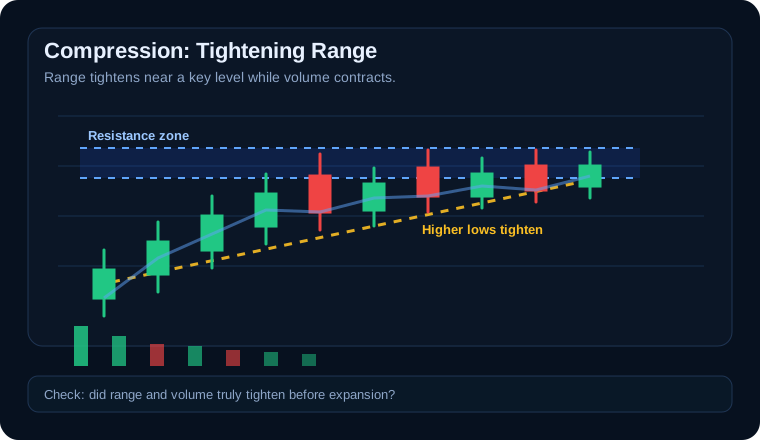
What Compression Means
Compression means the trading range is getting smaller.
Price may still be moving, but each push and pullback is becoming tighter than before.
Compression may show up as:
- Smaller candles
- Smaller pullbacks
- Higher lows pressing into resistance
- Lower highs pressing into support
- Volume drying up before expansion
- Price staying near a key level
- A tighter range that becomes easier to define
The best compression is usually easy to see. The chart starts to look like it is squeezing into a smaller area.
Why Traders Watch Compression
Traders watch compression because tightening price action can make the next important level clearer.
Instead of chasing a large candle after it has already moved, a trader can study whether price tightened first.
Compression helps answer:
- Is price building pressure near resistance?
- Is price pressing into support?
- Are pullbacks getting smaller?
- Is volume drying up before a possible expansion move?
- What level defines the top of the tight range?
- What level defines the bottom of the tight range?
Compression gives the trader a cleaner area to watch. It does not decide the outcome.
Compression Versus Consolidation
Compression and consolidation are related, but they are not the same thing.
Consolidation means price is moving sideways or digesting a move.
Compression is more specific. It means the range is tightening.
A stock can consolidate without compressing. It may move sideways in a wide, messy range.
Compression usually feels tighter. The highs and lows start moving closer together. The candles may shrink. Price may press toward one side of the range.
The next lesson covers consolidation more broadly. This lesson focuses on the tightening version.
What Useful Compression Looks Like
Useful compression usually has a clear area.
The trader should be able to mark the top and bottom of the tightening range without forcing it.
A cleaner compression read may show:
- Price tightening near a meaningful level
- Pullbacks becoming smaller
- Volume contracting before expansion
- A clear upper level and lower level
- A defined area where the idea would fail
- Nearby support or resistance that helps frame the range
For example, price may run to $2.90, pull back to $2.65, then keep pressing between $2.78 and $2.90. Each pullback is smaller than the last.
That is different from random candles moving sideways with no clear tightening.
Compression Near Resistance
Compression near resistance often shows price pressing into an upper level.
Buyers keep bringing price back toward resistance, while pullbacks get smaller.
A cleaner upside compression read may show:
- A clear resistance area
- Higher lows forming below resistance
- Volume drying up during the tight range
- Price staying near the upper part of the range
- A clear level where the compression fails if price loses the range
This can set up a cleaner breakout read later, but the breakout still needs to happen and hold.
The compression itself does not guarantee the break.
Compression Near Support
Compression can also happen near support.
This may show price pressing down into a lower level while bounces get weaker.
A cleaner downside compression read may show:
- A clear support area
- Lower highs forming above support
- Volume drying up before the next move
- Price staying near the lower part of the range
- A clear level where the compression fails if price reclaims the range
This can set up a cleaner breakdown read later, but again, the breakdown still needs to happen and hold.
Volume During Compression
Volume often contracts during compression because price is tightening and fewer traders are willing to push the move yet.
Then, when price finally breaks the range, traders may look for volume to expand.
A common sequence is:
- Price makes a move.
- Price tightens into a smaller range.
- Volume dries up during the tight range.
- Price breaks out or breaks down.
- Volume expands during the move.
That sequence is useful, but not required every time.
Volume is one piece of the read. Price still has to hold the break.
Failed Compression Break
A failed compression break happens when price leaves the tight range but cannot stay outside it.
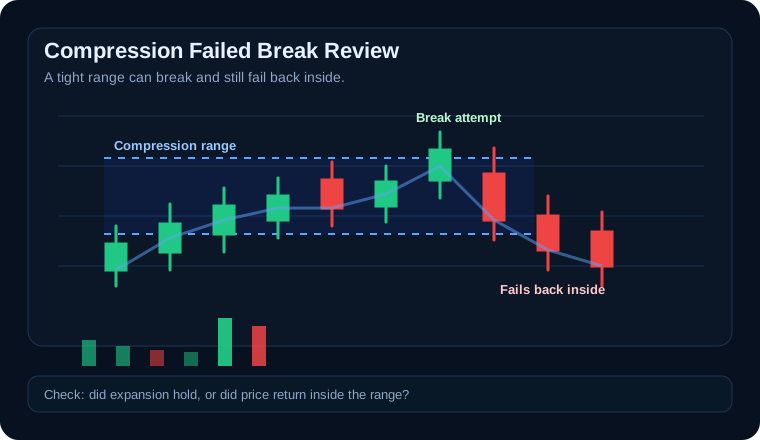
For example, price may compress under resistance, break above it for one candle, then fall back inside the range.
That does not mean compression was useless. It means the first expansion attempt failed.
A failed compression break may show:
- The range was tight before the break.
- Price broke outside the range.
- Volume did not follow through.
- Price returned back inside the range.
- The trader anticipated too early or chased after the break.
The failed break becomes part of the lesson. It shows where price tried to resolve the range and could not hold the new area.
Random Chop Is Not Compression
This is one of the most important beginner lessons.
Not every sideways chart is compression.
Random chop may have:
- Wide candles
- Messy overlapping action
- No clear upper or lower edge
- Sudden wicks in both directions
- No tightening range
- No meaningful level nearby
- Volume that does not tell a clear story
Compression should make the chart feel more defined. Chop usually makes it feel less defined.
If the trader cannot clearly explain what is tightening, it may not be compression.
Realistic Example
A stock runs to $2.90, pulls back to $2.65, then starts tightening under $2.90.
The next pullback holds $2.74. The next one holds $2.80. Then price keeps pressing between $2.82 and $2.90 while volume dries up.
A trader may mark:
- $2.90 as resistance
- $2.80 to $2.82 as the lower edge of compression
- Volume contraction during the tight range
- The breakout level above $2.90
- The failure area below the lower edge
A cleaner upside break might show price clearing $2.90 with volume and holding above it.
A failed break might show price popping above $2.90, losing volume, and falling back inside the range.
The compression gave the trader a clear area to study. The break still had to prove itself.
What Beginners Usually Get Wrong
The biggest mistake is trying to guess the direction too early.
Compression means pressure is building. It does not tell the trader which side has already won.
Common mistakes include:
- Entering before the range is actually tight
- Assuming compression always breaks upward
- Ignoring the lower edge of the range
- Ignoring volume on the break
- Confusing random chop with compression
- Chasing after the expansion candle is already extended
- Drawing the compression range only after the move happens
- Holding after price fails back inside the range
Compression should improve patience. If it makes the trader more impatient, it is being used poorly.
What To Watch During Compression
When price starts tightening, watch the range.
Ask:
- Is the range actually getting smaller?
- Are candles shrinking or still wide and messy?
- Are pullbacks getting smaller?
- Is price compressing near a meaningful level?
- Is volume drying up during the tight range?
- What is the upper edge of the range?
- What is the lower edge of the range?
- What would a failed break look like?
The clearer the range, the easier it is to study the move after it resolves.
How This Helps When Studying Charts Or Trades
Compression helps traders study whether patience was rewarded or whether the trade was anticipated too early.
When looking back at a chart or completed trade, ask:
- Was the range actually tightening before the move?
- Was the range marked before the break?
- Did price break the range with volume?
- Did price hold outside the range or fall back inside?
- Did the trader enter before the break was clear?
- Did the trader chase after the expansion candle?
- Was the chart compressing, or was it just random chop?
This keeps compression practical. The goal is not to predict the move. The goal is to recognize when price is tightening and know what would confirm or fail the range.
Key Takeaway
Compression is tightening price action.
It can help traders see pressure building near a level, but it does not choose the direction for them. The useful read comes from the range, the volume, the break, and whether price holds outside the compressed area.
Do not predict the squeeze. Read the range.
Related Lessons
FAQ
What is compression trading?
Compression trading focuses on tightening price action where the range gets smaller before a possible expansion move.
Is compression the same as consolidation?
No. Consolidation is broader sideways digestion. Compression is more specific because the range is tightening.
Does compression predict direction?
No. Compression shows price tightening, but the move can break higher, break lower, fake out, or stay choppy.
What makes compression useful?
Compression is more useful when the range is clear, the candles are tightening, volume is contracting, and price is near a meaningful level.
What is a failed compression break?
A failed compression break happens when price leaves the tight range but cannot hold outside it and falls back inside.
What should beginners watch during compression?
Beginners should watch the upper edge, lower edge, volume behavior, whether the range is truly tightening, and whether price holds after leaving the range.