
Track your progress
To save this lesson to your Academy progress, join the free TradersLink Discord and log in with your Discord account.
Log in with DiscordPremarket High Low: How Traders Read The Early Range
Premarket high and premarket low mark the highest and lowest prices a stock trades before the regular market session opens.
Traders often shorten them to:
- PMH for premarket high
- PML for premarket low
These levels matter most to day traders because they help create the first map for the open.
Before the bell, price may already have reacted to news, filings, earnings, sector movement, or scanner attention. PMH and PML show the top and bottom of that early range.
The key question is not only where the premarket high and low are.
The better question is:
What does price do around those levels after regular-session volume arrives?
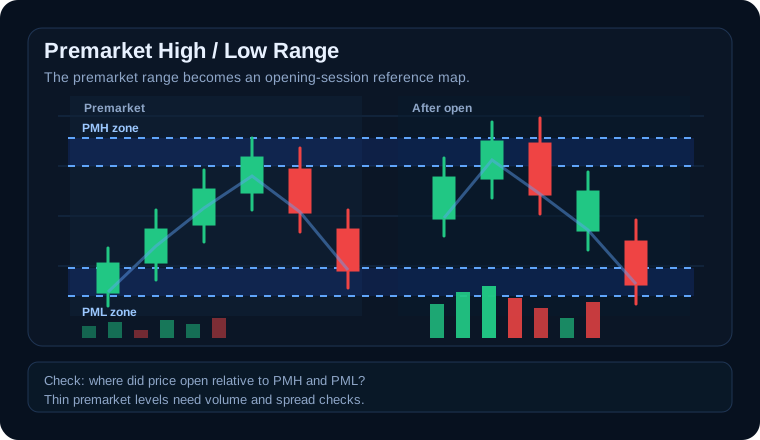
What Premarket High Means
Premarket high is the highest price a stock reaches before the regular session opens.
Traders watch it because it can become an important reference area during the open.
PMH may act like:
- A resistance area
- A breakout level
- A failed breakout area
- A retest area after price breaks above it
- A level where early buyers or late chasers may be tested
For example, if a stock runs to $2.65 before the open and cannot get above it, $2.65 becomes the premarket high.
After the open, traders may watch whether price breaks above $2.65, rejects there, or pushes above and fails back below it.
What Premarket Low Means
Premarket low is the lowest price a stock reaches before the regular session opens.
Traders watch it because it can become a support, breakdown, or reclaim reference area during the open.
PML may act like:
- A support area
- A breakdown level
- A failed breakdown area
- A reclaim level
- A warning area if early buyers lose control
For example, if a stock pulls back to $2.20 before the open and holds there, $2.20 becomes the premarket low.
After the open, traders may watch whether price holds $2.20, breaks below it, flushes below and reclaims, or loses it cleanly.
Why Premarket Levels Are Useful
Premarket high and low are useful because they show the early range before regular trading begins.
They help answer:
- Is price opening near the top of the premarket range?
- Is price opening near the bottom of the premarket range?
- Did price already test the premarket high before the open?
- Did price already test the premarket low before the open?
- Is the stock opening inside the premarket range or outside it?
- Is there real volume behind the premarket move?
This gives the trader a starting map.
Without PMH and PML, the market open can look like random speed. With them, the trader can see whether price is breaking, rejecting, reclaiming, or staying inside the early range.
Premarket Levels Need Volume Context
Premarket trading can be thin.
That is why PMH and PML need context. A level formed by one odd print on very low volume is not the same as a level formed after repeated trading and real participation.
A stronger premarket level usually has:
- Real volume near the level
- More than one candle reacting around the area
- A reasonable spread
- A visible catalyst or reason for attention
- Price respecting the area more than once
A weaker premarket level may have:
- Very low volume
- One thin wick
- A wide spread
- No clear catalyst
- No follow-through after the print
The level can still be marked, but the trader should know whether it came from real participation or thin premarket noise.
Chart Settings Matter
Different platforms can display premarket data differently.
Some charts include extended-hours candles by default. Some do not. Some brokers show different levels depending on data access, routing, or the venues included in the feed.
That means a trader should know how their platform defines premarket high and low.
This matters because a single thin extended-hours print can change the level on one chart while another chart may show a cleaner range.
The simple rule:
Use the same chart settings for planning and later chart study.
If the level came from a thin candle, note that. If it came from repeated volume, give it more attention.
What Happens After The Open
Premarket levels become more interesting after regular-session volume arrives.
After the open, price may:
- Break above premarket high
- Reject at premarket high
- Break above premarket high and fail back below it
- Pull back and hold premarket high after breaking it
- Break below premarket low
- Flush below premarket low and reclaim it
- Trade inside the premarket range
The open tests the quality of the premarket levels.
A level that looked important before the bell may become more important if regular-session traders react to it. It may also become less important if price ignores it completely.
Failed Breakout At Premarket High
A failed breakout at PMH happens when price pushes above the premarket high but cannot stay above it.
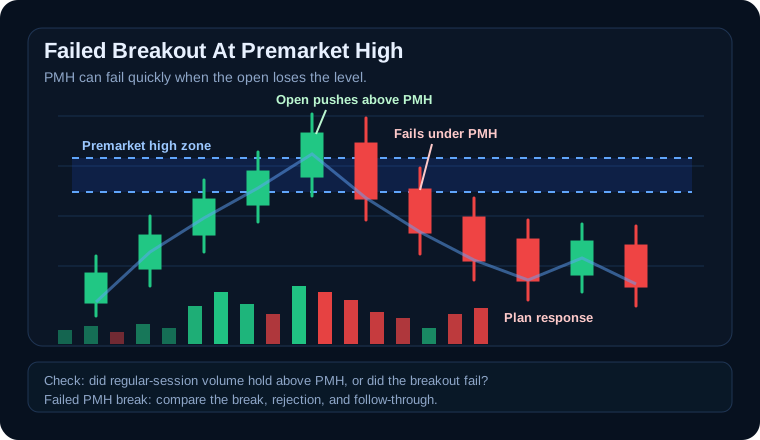
This can happen when price breaks an obvious level, attracts late entries, then falls back under the same area.
A failed PMH breakout may show:
- PMH was marked before the open.
- Price broke above it after the open.
- Volume faded or sellers appeared.
- Price fell back below PMH.
- The level became a failed breakout area.
The level did not become useless. It became useful in a different way.
It showed where price tried to leave the early range and failed.
Premarket Low Reclaim
A premarket low reclaim happens when price breaks below PML, then moves back above it.
This can matter because price first showed weakness below the early range, but then won the level back.
A PML reclaim may show:
- Price lost premarket low.
- Sellers could not keep price below it.
- Price moved back into the premarket range.
- The next candles held above the reclaimed area.
The key question is whether price can stay back above PML. A quick reclaim that immediately fails is different from a reclaim that holds and builds.
Realistic Example
A stock releases news at 7:00 a.m. and trades from $1.80 to a premarket high of $2.65.
It pulls back to $2.20, then holds above $2.25 into the open.
A trader may mark:
- $2.65 as premarket high
- $2.20 to $2.25 as premarket low/support area
- Previous day high and low for broader context
After the open, price pushes toward $2.65.
A cleaner PMH breakout read might show:
- Price breaks above $2.65.
- Regular-session volume increases.
- Price holds above PMH.
- A pullback stays near or above the level.
A weaker read might show:
- Price spikes above $2.65.
- Volume fades.
- Price falls back below PMH.
- The move becomes a failed breakout.
Later, if price loses $2.20 and then reclaims it, PML becomes part of the reclaim story.
The levels are not the full plan. They organize the open.
Premarket High Low Versus Previous Day High Low
Premarket high and low are different from previous day high and low.
PDH and PDL come from the prior regular session. PMH and PML come from today’s extended-hours trading before the open.
Both can matter.
A strong day-trading map may include:
- Previous day high
- Previous day low
- Premarket high
- Premarket low
- Current price
- Nearby support and resistance
For example, if PMH lines up near PDH, that area may get more attention. If PMH is far above PDH after major news, the trader needs to understand that price is already outside yesterday’s range.
The levels work best together, not separately.
What Beginners Usually Get Wrong
The biggest mistake is treating premarket levels like they are automatically strong.
Sometimes they are useful. Sometimes they are thin and messy.
Common mistakes include:
- Not marking PMH and PML before the open
- Treating one thin premarket wick as a major level
- Ignoring volume behind the level
- Ignoring wide spreads before the open
- Buying just because price breaks PMH
- Shorting just because price breaks PML
- Chasing into PMH after a large gap-up move
- Ignoring a failed PMH breakout
- Ignoring a PML reclaim after an open flush
- Forgetting to compare PMH and PML with previous day levels
Premarket levels help with preparation. They should not replace the full chart read.
What To Watch Around PMH And PML
When price reaches premarket high or low, watch the reaction.
At PMH, ask:
- Does price reject from the premarket high?
- Does price break above and hold?
- Does price break above and fail back below?
- Does regular-session volume support the move?
- Is price already extended before reaching it?
At PML, ask:
- Does price hold premarket low?
- Does price break below and stay below?
- Does price flush below and reclaim?
- Is volume expanding during the break?
- Is there another support area nearby?
The level is the reference point. The open-session reaction tells the story.
How This Helps When Studying Charts Or Trades
Premarket high and low help traders study whether the open had a clear map.
When looking back at a chart or completed trade, ask:
- Were PMH and PML marked before the open?
- Did the levels form on meaningful volume or thin prints?
- Was price opening near PMH, near PML, or in the middle?
- Did regular-session volume respect or ignore the level?
- Did price hold, break, reject, or reclaim the level?
- Was the decision made near the level or after the move was extended?
- Did the trader compare premarket levels with previous day levels?
This keeps premarket levels practical. They help traders understand the open instead of reacting to every fast candle.
Key Takeaway
Premarket high and premarket low show the early range before the regular session opens.
They can be useful reference levels, especially on active stocks with real volume and a clear catalyst. But premarket levels can also be thin, noisy, or distorted by wide spreads.
Mark PMH and PML before the open. Then watch how regular-session price reacts around them.
Related Lessons
- Key Levels Trading
- Previous Day High Low
- Support and Resistance
- High of Day
- Breakout Trading
- Breakdown Trading
FAQ
What does premarket high mean?
Premarket high is the highest price a stock reaches during premarket trading before the regular session opens.
What does premarket low mean?
Premarket low is the lowest price a stock reaches during premarket trading before the regular session opens.
Why do traders watch premarket high?
Traders watch premarket high because it marks the top of the early range and can become a breakout, resistance, failed breakout, or retest area after the open.
Why do traders watch premarket low?
Traders watch premarket low because it marks the bottom of the early range and can become support, a breakdown area, or a reclaim level after the open.
Are premarket levels reliable?
They can be useful, but quality depends on volume, liquidity, spread, catalyst strength, and whether regular-session traders respect the level after the open.
What should beginners watch around PMH and PML?
Beginners should watch whether price holds, breaks, rejects, reclaims, or ignores those levels after regular-session volume arrives.