
Track your progress
To save this lesson to your Academy progress, join the free TradersLink Discord and log in with your Discord account.
Log in with DiscordLow of Day: How Traders Read The Session Low
Low of day is the lowest price a stock has reached so far during the current trading session.
Traders often shorten it to LOD.
LOD matters because it shows the weakest price point of the session up to that moment. If price is fading toward LOD, traders know it is testing the bottom of the current session range. If price breaks below LOD, a new low of day is created.
That can show weakness, but weakness by itself is not the full read.
The useful question is:
Is price breaking LOD with structure, volume, and room, or is it chasing into an extended downside move?
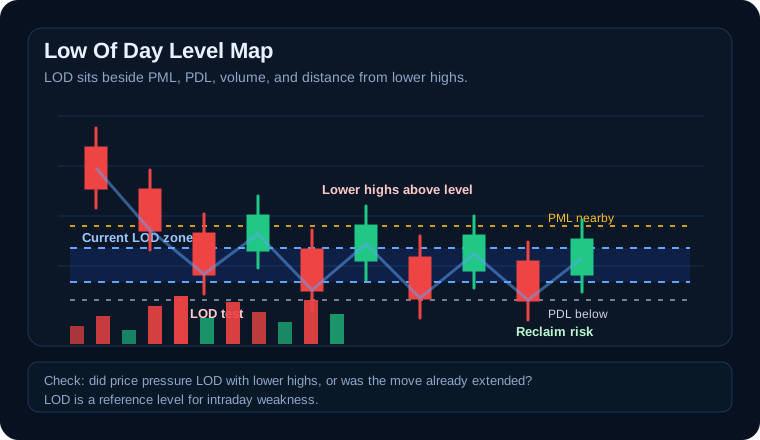
What Low Of Day Means
Low of day is the current session’s lowest traded price.
If a stock opens at $4.20 and sells off to $3.75, then $3.75 is low of day.
If price later trades at $3.68, then $3.68 becomes the new low of day.
LOD updates during the session whenever price trades below the prior session low.
For most intraday lessons, LOD usually refers to the regular session unless the platform or scanner is set to include extended-hours prints. That setting matters because premarket low and regular-session low of day are not always the same thing.
LOD Versus New Low Of Day
Low of day is the level.
New low of day is the event.
For example:
- Price sells off to $3.75.
- $3.75 becomes LOD.
- Price bounces to $3.95.
- Later, price breaks below $3.75.
- That break creates a new low of day.
This lesson focuses on LOD as a reference level. A new low of day is the live event of price breaking below that level.
Why Traders Watch LOD
Traders watch low of day because it is one of the most visible intraday support or weakness levels.
It may act like:
- Intraday support
- A breakdown reference level
- A failed breakdown area
- A reclaim level after a flush
- A risk line for long trades
- A downside extension area
LOD can tell the trader where price is compared with the weakest point of the session so far.
But LOD should not be read alone. It matters more when combined with premarket low, previous day low, support, volume, spread, liquidity, and distance from the latest lower high.
How LOD Forms And Updates
LOD is not fixed until the session ends.
It changes whenever price reaches a new session low.
A simple sequence might look like this:
- A stock opens at $4.20.
- It sells off to $3.75.
- $3.75 becomes LOD.
- It bounces to $3.95.
- It later drops to $3.68.
- $3.68 becomes the new LOD.
Each time LOD updates, the trader should still ask whether price is moving cleanly or becoming extended.
A new LOD after lower highs press into support is different from a new LOD after five straight red candles with no pause.
A Clean LOD Test
A cleaner LOD test usually has structure above it.
Price may bounce, form lower highs, consolidate, or keep pressing into the level before testing it again.
A cleaner LOD read may show:
- LOD was clear before the test.
- Price bounced and formed a lower high.
- Volume increased as price returned to LOD.
- The spread stayed manageable.
- Price had room before the next major support level.
- The entry or exit was not far below the LOD area.
This does not mean every clean LOD break continues lower. It means the chart has a better story than a random flush into a fresh low.
Failed LOD Breakdown
A failed LOD breakdown happens when price breaks below low of day but cannot stay below it.
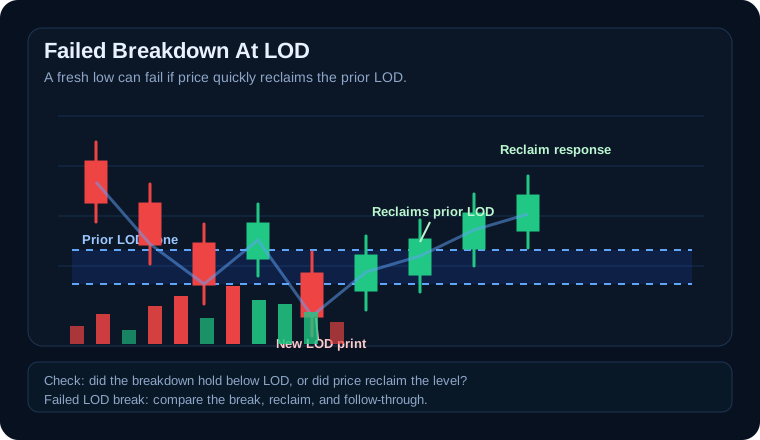
This is common because LOD is obvious. Obvious levels can attract panic exits, breakdown traders, short sellers, and fast scanner attention.
A failed LOD breakdown may show:
- Price breaks below LOD.
- Volume fades after the break.
- Price reclaims the LOD level.
- The next candles hold above the reclaimed area.
- The move becomes a failed breakdown area.
The LOD level did not become useless. It became useful in a different way. It showed where price tried to make a fresh session low and failed.
Extension Risk Around LOD
A stock can be weak and still be extended lower.
This is one of the most important LOD lessons.
A move into LOD can become risky when:
- Price is far below the nearest resistance or reclaim area.
- Price is far below the latest lower high.
- The move into LOD is nearly vertical.
- Volume spikes late after most of the move is already done.
- LOD sits directly above premarket low, previous day low, or daily support.
- The spread is wide or liquidity is thin.
- The trader is reacting to a scanner alert instead of reading the chart.
A fresh low can look weak, but the entry or exit location may already be difficult to manage.
The trader needs to separate weakness from location.
Realistic Example
A stock opens at $4.20 and sells off to $3.75.
It bounces to $3.95, forms a lower high, then starts fading back toward $3.75.
A trader may watch $3.75 as LOD.
A cleaner LOD breakdown read might show:
- Price formed lower highs above LOD.
- Volume increased as price returned to $3.75.
- Price broke below $3.75 and stayed below it.
- Old LOD rejected price on a retest.
- PML or PDL was not directly underneath.
A weaker LOD breakdown read might show:
- Price went straight down without a controlled bounce.
- The entry came far below $3.75.
- Volume faded after the new low.
- Price quickly reclaimed LOD.
- A larger support level was directly below the move.
Both examples include a low of day test. They are not the same quality.
LOD With Premarket Low And Previous Day Low
Low of day should be read with nearby reference levels.
If LOD is near premarket low, the stock may be testing two important levels at once. If LOD is near previous day low, the level may matter even more because it connects the current session with yesterday’s range.
For example:
- LOD is $2.04.
- Premarket low is $2.00.
- Previous day low is $1.96.
A trader should understand that price is not just making a fresh intraday low. It is also pushing into a cluster of nearby support reference levels.
That does not mean price cannot break down. It means the level map matters.
Day Trading Versus Swing Trading Context
Low of day is mostly an intraday level.
Day traders watch it because it changes during the session and often attracts short-term attention.
Swing traders may still notice LOD, but it usually matters less than daily support, daily resistance, multi-day lows, or larger structure.
A day trader might use LOD to understand intraday weakness and breakdown behavior.
A swing trader might only care if the LOD also lines up with a larger daily level.
The level should match the trade style.
What Beginners Usually Get Wrong
The biggest mistake is treating LOD like an automatic trade idea.
LOD is a level. It is not a plan.
Common mistakes include:
- Buying only because price is near low of day
- Shorting only because price made a new low of day
- Averaging down after a new LOD
- Ignoring how far price is from the latest lower high
- Ignoring PML, PDL, or daily support nearby
- Treating every LOD break as a clean breakdown
- Holding after price reclaims LOD against the idea
- Entering far below the level that made the move interesting
LOD should make the chart clearer. If it only creates panic or urgency, the trader may be reacting to weakness instead of reading the setup.
What To Watch Around LOD
When price approaches or breaks low of day, watch the reaction.
Ask:
- Are lower highs forming above LOD?
- Is volume increasing into the test?
- Is price extended from the latest lower high?
- Is PML, PDL, or daily support nearby?
- Does price break below LOD and stay below?
- Does price break below LOD and reclaim quickly?
- Is the entry or exit near the level or far below it?
- Did the trader plan the level before the alert?
The LOD level is the reference point. The behavior around it is the lesson.
How This Helps When Studying Charts Or Trades
Low of day helps traders study whether they were reading support pressure or reacting to the newest low.
When looking back at a chart or completed trade, ask:
- Where was LOD before the decision?
- Were lower highs pressing into it?
- Did the break below LOD hold or reclaim?
- Was the entry or exit near LOD or far below it?
- Was price already extended from the latest lower high?
- Were other support reference levels nearby?
- Did the trader respond if LOD reclaimed?
This keeps LOD practical. The goal is not to react to every fresh low. The goal is to understand whether the low of day level gave a clean chart read.
Key Takeaway
Low of day is the weakest price point of the current session so far.
It can become intraday support, a breakdown reference, a failed breakdown area, or a downside chase-risk zone. The important part is not only that price reaches LOD. The important part is how price behaves around it.
Do not chase the newest low. Read the LOD area.
Related Lessons
- High of Day
- Key Levels Trading
- Support Levels
- Premarket High Low
- Lower Highs and Lower Lows
- Breakdown Trading
FAQ
What does low of day mean?
Low of day is the lowest price a stock has reached so far during the current trading session.
What does LOD mean?
LOD stands for low of day.
How is low of day different from new low of day?
Low of day is the current session low level. New low of day is the event of price breaking below the previous session low of day level.
Is low of day the same as premarket low?
Not always. Low of day usually refers to the current regular-session low, while premarket low is the lowest price reached before the regular session opens.
Why do traders watch LOD?
Traders watch LOD because it can act as intraday support, a breakdown reference, a failed breakdown area, or a reclaim level after a flush.
What should beginners watch around LOD?
Beginners should watch whether lower highs are pressing into LOD, whether price breaks and holds below it, whether it reclaims quickly, or whether it is extended into nearby support.