
Track your progress
To save this lesson to your Academy progress, join the free TradersLink Discord and log in with your Discord account.
Log in with DiscordHead And Shoulders Pattern
Best suited for: day trading and swing trading.
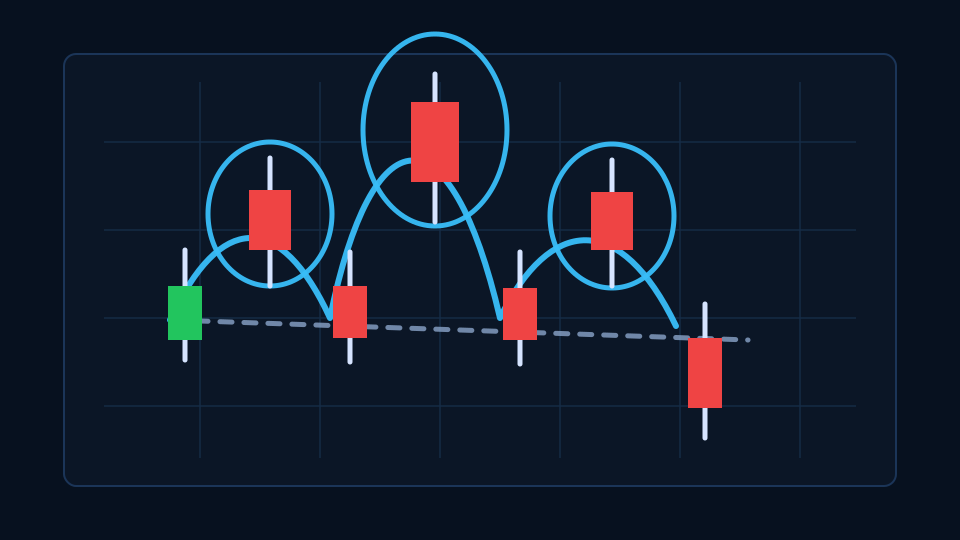
A head and shoulders pattern forms when price makes a high, then a higher high, then a lower high while holding a neckline area underneath. It can show a move losing strength near resistance.
The pattern needs neckline and follow-through context. Without that, the chart may only be showing normal swings near a high.
What It Is
A head and shoulders pattern is a weakening-structure pattern.
- Left shoulder reaction high.
- Higher head.
- Right shoulder lower high.
- Neckline support area.
- Neckline break, reclaim, or failed break.
The right shoulder matters because it shows price failing to make another strong high.
Pattern Structure
The left shoulder starts the resistance area. The head pushes higher. The right shoulder fails to match the head. The neckline shows where support is being tested.
A cleaner pattern has a clear neckline and enough spacing between the three peaks that the structure is visible without forcing it.
Clean Vs Forced Versions
A clean head and shoulders pattern has three readable swings, a clear neckline, and a right shoulder that shows weaker upward pressure.
A forced version appears when the trader stretches the pattern over random candles, ignores uneven neckline behavior, or labels a normal pullback as a major structure shift.
Context That Matters
Head and shoulders patterns need structure and neckline context.
- Trend before the pattern.
- Quality of the neckline support area.
- Volume on the head and right shoulder.
- Whether the neckline break holds or reclaims.
- Nearby higher-timeframe levels.
- Distance from the neckline to the next support area.
When It Can Mislead
Head and shoulders patterns mislead when traders focus on the shape while ignoring the neckline. A pattern can fail if the neckline holds, reclaims quickly, or sits above stronger support.
Example Chart Read
A stock makes a new high, pulls back, pushes to a higher high on weaker volume, then forms a lower high near resistance. Price tests the neckline and briefly breaks it, but then reclaims. The next read is whether the neckline break holds or turns into a failed breakdown.
Common Mistakes
One common mistake is seeing a head and shoulders pattern in every choppy top.
Another mistake is ignoring the neckline.
Traders also make mistakes when they enter late after the neckline move is already extended.
Another mistake is missing a fast reclaim back above the neckline.
A final mistake is forgetting that the broader trend can still matter.
Related Lessons
Key Takeaway
A head and shoulders pattern is useful only when the three swings, neckline, volume, and reclaim or breakdown behavior are clear enough to review.
FAQ
What is a head and shoulders pattern?
It is a pattern with a left shoulder, higher head, lower right shoulder, and neckline support area.
What makes it cleaner?
Clear swings, a visible neckline, weaker right-shoulder behavior, volume context, and a defined failure area.
Why can it fail?
It can fail when the neckline holds, quickly reclaims, or the pattern was forced onto normal choppy price action.
Is the neckline important?
Yes. The neckline is the area that helps turn the shape into a reviewable structure.