
Track your progress
To save this lesson to your Academy progress, join the free TradersLink Discord and log in with your Discord account.
Log in with DiscordConsolidation Trading: How Traders Read Sideways Ranges
Consolidation happens when price stops trending clearly and starts moving sideways inside a range.
The stock may have just made a strong move. It may be resting, digesting, waiting for volume, or rotating between support and resistance. Instead of continuing straight up or straight down, price pauses and starts building a range.
A beginner can think of consolidation as the chart taking a breath.
That does not mean the next move is known. A consolidation can break higher, break lower, fake out, or keep moving sideways longer than expected.
The value is in reading the range clearly.
What Consolidation Means
Consolidation means price is moving sideways instead of trending strongly.
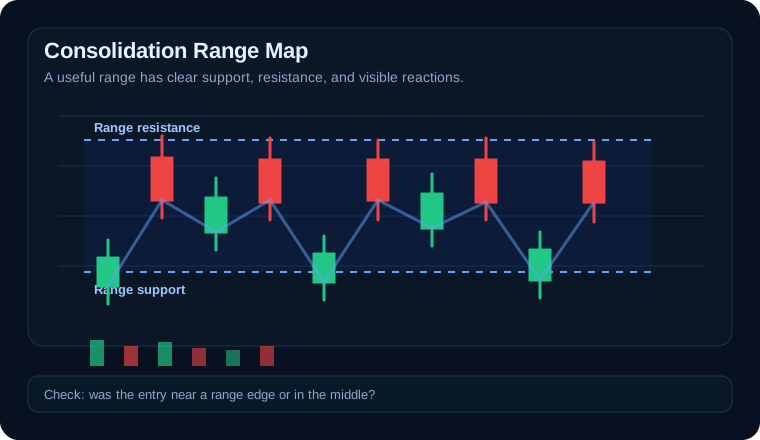
A consolidation range usually has an upper area and a lower area.
The upper area may act like resistance. The lower area may act like support.
Inside the range, price may rotate back and forth. It may reject near the top, bounce near the bottom, or chop around the middle.
A useful consolidation should have edges that can be explained. If the range is too messy to mark, it may be chop rather than a clean consolidation.
Consolidation Versus Compression
Consolidation and compression are related, but they are not the same thing.
Compression means the range is tightening.
Consolidation is broader. It simply means price is moving sideways or digesting a move.
A consolidation can be wide, flat, messy, or clean. It may tighten into compression later, but it does not have to.
For example:
- A stock moving between $3.80 and $4.05 for thirty minutes may be consolidating.
- If that range starts tightening from $3.85 to $4.05, then $3.92 to $4.02, then $3.96 to $4.00, it may also be compressing.
The difference matters because compression often shows pressure narrowing. Consolidation may simply show sideways digestion.
Why Traders Watch Consolidation
Traders watch consolidation because it can create structure after a move.
After a strong run, price may need time to settle. If it holds a range instead of giving back the entire move, the chart may become easier to read.
Consolidation helps answer:
- Where is the top of the range?
- Where is the bottom of the range?
- Is price holding above an important level?
- Is volume calming down after a large move?
- Is the range clean enough to matter?
- Is price breaking out, breaking down, or still rotating?
A clean range can help a trader avoid chasing the first move and instead study what price does during the pause.
A Useful Consolidation Range
A useful consolidation range is clear enough to mark before the next move.
It usually has:
- A visible upper edge
- A visible lower edge
- Enough time in the range to matter
- Price respecting the range more than once
- A connection to nearby support or resistance
- A way to tell when the range has failed
For example, a stock runs from $3.00 to $4.10, then spends thirty minutes trading between $3.85 and $4.05.
That range gives the trader a map:
- $4.05 is range resistance.
- $3.85 is range support.
- A break above $4.05 is an upside range break.
- A loss of $3.85 is a downside range break.
The range becomes useful because it gives the chart structure.
Consolidation After A Strong Move
Consolidation often appears after a strong move.
A stock may run quickly, then stop moving straight up. Instead of fading hard, it holds a sideways range.
That can show that price is digesting the move.
But digestion is not the same as guaranteed strength.
A strong consolidation read might show:
- Price holds above the main breakout area.
- Pullbacks stay controlled.
- Volume calms down but does not disappear completely.
- The range has a clear top and bottom.
- Price does not give back too much of the original move.
A weaker consolidation read might show:
- Price chops violently inside the range.
- The lower edge keeps getting tested.
- Bounces inside the range become weaker.
- Volume fades too much.
- Price loses the range and cannot reclaim it.
The consolidation is only useful if the behavior inside the range can be read clearly.
Failed Range Break
A failed range break happens when price moves outside consolidation but cannot stay outside the range.
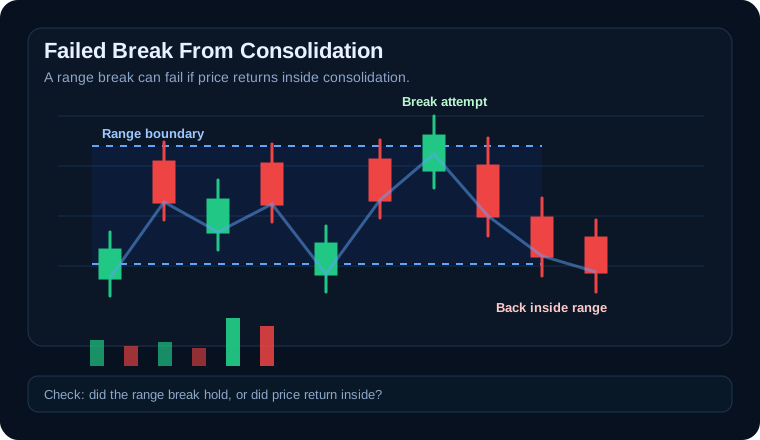
For example, price may break above range resistance, attract breakout attention, then fall back inside the range.
That first break did not hold.
A failed upside range break may show:
- The range was clear before the break.
- Price moved above range resistance.
- Volume did not follow through.
- Price fell back inside the range.
- The trader chased the break instead of reading the hold.
A failed downside range break works the same way in reverse. Price breaks below range support, fails to stay below, and reclaims the range.
The failed break becomes part of the lesson. It shows where price tried to leave the range and could not hold the new area.
Range Middle Is Usually Harder
The middle of a consolidation range is often the hardest place to make sense of price.
Near the top of the range, the trader can watch resistance behavior. Near the bottom, the trader can watch support behavior. In the middle, price may have less clear risk and less clear direction.
That is why many beginners overtrade consolidation.
They buy in the middle, sell in the middle, flip opinions in the middle, and then get chopped up as price rotates.
A good range read often starts with patience:
- Know the top.
- Know the bottom.
- Avoid making every middle candle important.
- Wait for price to interact with an edge or show a clearer shift.
The range edges usually teach more than the middle.
Realistic Example
A stock runs from $3.00 to $4.10 in the morning.
After the run, it spends thirty minutes trading between $3.85 and $4.05.
A trader may mark:
- $4.05 as range resistance
- $3.85 as range support
A cleaner upside read might show:
- Price holds above $3.85.
- Pullbacks inside the range stay controlled.
- Volume calms down during the range.
- Price breaks above $4.05 with volume.
- Price holds above the range after the break.
A weaker read might show:
- Price breaks above $4.05 and falls back inside.
- Price keeps testing $3.85.
- Bounces inside the range get weaker.
- Price loses $3.85 and cannot reclaim it.
The range gives the trader a map. The reaction at the edges tells the story.
Consolidation In Day Trading And Swing Trading
Consolidation can appear on any timeframe.
A day trader may watch intraday consolidation after a morning move, near high of day, near VWAP, or under premarket high.
A swing trader may watch daily consolidation after a multi-day run, around a base, or near a larger resistance area.
The idea is the same. Price is moving sideways and building a range.
The difference is the timeframe.
A fifteen-minute consolidation may matter for a day trade. A multi-week consolidation may matter for a swing trade. The range should match the style of trade being studied.
What Beginners Usually Get Wrong
The biggest mistake is assuming consolidation always breaks upward.
It does not.
A consolidation can resolve higher, resolve lower, fake out, or keep chopping sideways.
Common mistakes include:
- Entering before the range is clear
- Buying the middle of the range with no plan
- Assuming every sideways pause is bullish
- Ignoring the lower edge of the range
- Holding after range support fails
- Chasing after a breakout candle is already extended
- Confusing random chop with useful consolidation
- Drawing a clean range only after the move already happened
- Overtrading every candle inside the range
A consolidation should help define structure. If it makes the trader take more random trades, it is being used poorly.
What To Watch During Consolidation
When price consolidates, watch the range.
Ask:
- Is the range clear enough to mark?
- Where is the upper edge?
- Where is the lower edge?
- Is price holding near the top, bottom, or middle?
- Is volume calming down or becoming random?
- Are bounces inside the range getting stronger or weaker?
- What would an upside break look like?
- What would a downside break look like?
- What would a failed range break look like?
The clearer the range, the easier it is to study what price does next.
How This Helps When Studying Charts Or Trades
Consolidation helps traders study whether they waited for structure or overtraded chop.
When looking back at a chart or completed trade, ask:
- Was the range clear before the decision?
- Was the entry near the range edge or in the middle?
- Did price break the range and hold?
- Did price break the range and fail back inside?
- Did the trader respect the lower edge if it failed?
- Was the chart consolidating, compressing, or just chopping around?
This keeps consolidation practical. The goal is not to force a pattern onto every sideways move. The goal is to understand whether the range helped the trader make better decisions.
Key Takeaway
Consolidation is sideways range behavior.
It can give traders a cleaner map after a move, but it does not choose the next direction. The useful read comes from the range edges, volume, failed breaks, and whether price holds or loses the range.
Do not predict the range. Read the edges.
Related Lessons
FAQ
What is consolidation trading?
Consolidation trading focuses on price moving sideways inside a defined range instead of trending clearly higher or lower.
Is consolidation the same as compression?
No. Consolidation is broader sideways range behavior. Compression is a tighter version where the range contracts.
Is consolidation bullish or bearish?
Consolidation is neutral by itself. Price can break higher, break lower, fake out, or continue moving sideways.
What makes consolidation useful?
Consolidation is more useful when the range has clear support and resistance edges that can be marked before the next move.
What is a failed consolidation breakout?
A failed consolidation breakout happens when price breaks outside the range but cannot stay outside it and falls back inside.
What should beginners watch during consolidation?
Beginners should watch the top of the range, bottom of the range, volume, whether price is in the middle, and whether a range break holds or fails.