
Track your progress
To save this lesson to your Academy progress, join the free TradersLink Discord and log in with your Discord account.
Log in with DiscordSwing Highs and Swing Lows: How Traders Read Structure
Swing highs and swing lows are the turning points that help traders understand the structure of a chart.
A swing high forms when price pushes up, stalls, and turns lower. A swing low forms when price drops, holds, and turns higher.
These turning points matter because structure is built from them. Before a trader can understand higher highs, higher lows, lower highs, lower lows, or a break of structure, they need to understand the basic turns on the chart.
The goal is not to label every candle. The goal is to mark the turns that actually help explain the move.
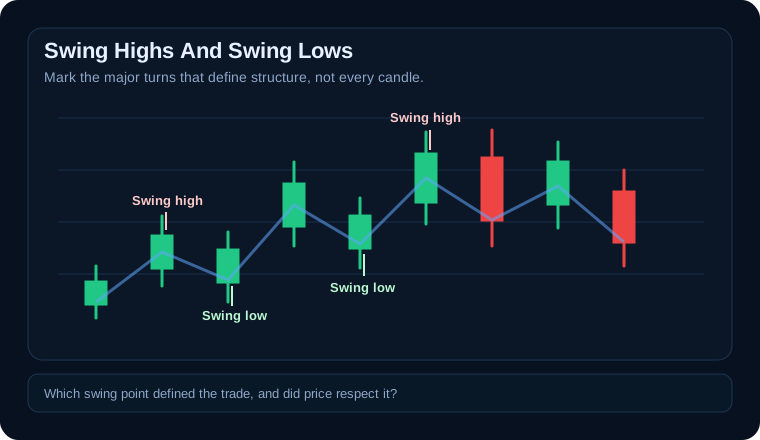
What A Swing High Is
A swing high is an area where price pushed higher and then turned down.
It often becomes visible only after price has pulled away from it. That is normal. A swing high is not just the highest candle on the screen. It is a meaningful turn that shows buyers were not able to keep pushing price higher from that area.
A swing high may form near:
- Resistance
- High of day
- Premarket high
- Previous day high
- A prior swing high
- The top of a range
- A failed breakout area
A swing high can later become resistance if price returns to that area and struggles again.
What A Swing Low Is
A swing low is an area where price dropped and then turned up.
It often becomes visible after price has bounced away from it. A swing low is not just one random red candle low. It is a meaningful turn that shows sellers were not able to keep pushing price lower from that area.
A swing low may form near:
- Support
- Low of day
- Premarket low
- Previous day low
- A prior swing low
- The bottom of a range
- A failed breakdown area
A swing low can later become support if price returns to that area and holds again.
Why Swing Points Matter
Swing highs and swing lows help a trader see the chart as a sequence instead of a pile of candles.
One candle can be noisy. A sequence of swing points tells a better story.
For example:
- Higher swing highs can show price is making progress upward.
- Higher swing lows can show buyers are stepping in sooner.
- Lower swing highs can show buyers are failing to push as far.
- Lower swing lows can show sellers are pushing price into weaker areas.
This is why swing points come before the next structure lessons. Higher highs and higher lows are built from swing highs and swing lows. Lower highs and lower lows are built from swing highs and swing lows too.
Do Not Label Every Candle
The biggest beginner mistake is marking every tiny candle turn as a swing point.
That makes the chart harder to read.
A useful swing point should stand out. It should be a visible turn that helps explain what price is doing. If the chart needs to be zoomed in too far to see it, it may not be important enough for the current read.
A good question is:
Would this turning point still matter if I stepped back from the chart?
If the answer is no, it may just be noise.
Timeframe Matters
A swing point depends on the timeframe.
A five-minute chart may show several intraday swing highs and lows. A daily chart may show only one or two larger swing points over the same period.
Neither one is automatically better. They answer different questions.
A day trader may care about intraday swings because those levels affect immediate decisions. A swing trader may care more about daily or multi-day swing points because the trade is meant to unfold over more than one session.
The mistake is mixing timeframes without knowing which one matters for the trade.
For example, a small five-minute swing low may not matter much if the daily chart is breaking a major support area. On the other hand, a daily swing low may be too far away to help manage a fast intraday trade.
How Swing Points Connect To Support And Resistance
Swing highs and swing lows often become the first places traders look for support and resistance.
A clear swing high can become a resistance area because price already turned down there. A clear swing low can become a support area because price already turned up there.
This is why the earlier support and resistance lessons matter. Swing points are often the raw turning points. Support and resistance are the areas traders build from those turns.
A clean swing high or swing low does not need to be perfect. It needs to be useful enough to help explain price location.
Realistic Example
Imagine a stock moves from $2.00 to $2.80, pulls back to $2.45, pushes to $3.05, pulls back to $2.70, then pushes again.
A trader might mark:
- Swing high near $2.80
- Swing low near $2.45
- Higher swing high near $3.05
- Higher swing low near $2.70
That sequence says buyers have been making progress so far. They pushed price to a higher high, then defended a higher pullback.
Now imagine price fails at $3.05, makes a lower high near $2.90, then loses $2.70. The structure starts to look different.
The individual candle does not tell the whole story. The sequence of swing points does.
Clean Swing Points Versus Forced Swing Points
A clean swing point is obvious.
Price moved into an area, turned, and the turn changed the chart. The swing point can be explained without forcing the line.
A forced swing point usually comes from trying too hard to label the chart. The trader marks a tiny wiggle, a small pause, or one random wick as if it were a major turn.
Clean swing points help answer:
- Where did price turn?
- Did buyers defend a higher area?
- Did sellers stop price at a lower area?
- What area would change the structure if lost or reclaimed?
Forced swing points create noise.
How Traders Use Swing Points
Traders may use swing highs and swing lows to:
- Mark possible support and resistance
- Read whether price is trending or ranging
- Identify higher highs and higher lows
- Identify lower highs and lower lows
- See where a trade idea may weaken
- Understand break of structure later in the course
- Avoid reacting to one candle without seeing the bigger sequence
The strongest use of swing points is simple: they help the trader see whether price is making progress, losing progress, or moving sideways.
What Beginners Usually Get Wrong
Common mistakes include:
- Labeling every tiny candle turn
- Ignoring timeframe
- Treating one higher low as a full trend
- Treating one lower high as a full reversal
- Drawing swing points only after the trade is over
- Ignoring nearby support and resistance
- Missing lower highs forming into support
- Missing higher lows forming under resistance
- Using swing points that do not affect the current trade idea
A useful swing point should simplify the chart. If it creates more confusion, the trader is probably marking too much.
What To Watch As Structure Develops
After marking the main swing highs and swing lows, watch how the next turns develop.
Ask:
- Is the next swing high higher or lower than the last one?
- Is the next swing low higher or lower than the last one?
- Are buyers defending pullbacks sooner?
- Are sellers stopping pushes earlier?
- Did price break a swing point that previously mattered?
- Is the chart trending, ranging, or getting messy?
This is where swing points become structure.
The next two lessons build directly on this idea: higher highs and higher lows show one type of structure, while lower highs and lower lows show another.
How This Helps When Studying Charts Or Trades
Swing points help traders look back at a chart and understand whether the decision matched the structure.
For example, buying near a higher swing low is different from buying after price has already made several extended pushes. Holding after the swing low that defined the idea has failed is different from holding while structure is still intact.
When studying a chart or completed trade, ask:
- Which swing high or swing low mattered most?
- Was the entry near structure or far away from it?
- Did price make progress after the entry?
- Did a key swing low fail?
- Did a key swing high reject?
- Was the structure clear before the decision, or only after the move?
This keeps structure practical. It is not just labeling. It is understanding where the chart turned and whether the idea still made sense.
Key Takeaway
Swing highs and swing lows are the basic turning points of market structure.
A swing high shows where price pushed up and turned down. A swing low shows where price dropped and turned up. The sequence of those turns helps traders read whether the chart is progressing, weakening, or moving without a clean direction.
Mark the turns that matter. Ignore the tiny wiggles.
Related Lessons
- Support and Resistance
- Key Levels Trading
- Higher Highs and Higher Lows
- Lower Highs and Lower Lows
- Break of Structure
- Price Rejection
FAQ
What is a swing high?
A swing high is a price area where price pushed higher, stalled, and turned lower.
What is a swing low?
A swing low is a price area where price dropped, held, and turned higher.
Why do swing highs and swing lows matter?
They help traders read market structure, mark possible support and resistance, and understand whether price is making progress or weakening.
Is every candle high a swing high?
No. A useful swing high should be a visible turn that helps explain the chart. Every tiny candle high does not need to be labeled.
Is every candle low a swing low?
No. A useful swing low should be a visible turn that helps explain the chart. Every tiny candle low does not need to be labeled.
How do swing points connect to market structure?
The sequence of swing highs and swing lows shows whether price is forming higher highs, higher lows, lower highs, lower lows, or a messy range.