
Track your progress
To save this lesson to your Academy progress, join the free TradersLink Discord and log in with your Discord account.
Log in with DiscordGap Fill Trading: How Traders Read Gap Areas
A gap happens when a stock opens meaningfully above or below where it traded in the prior session.
A gap fill happens when price later moves back through some or all of that empty space on the chart.
Traders watch gaps because they can become important reference areas. A gap can show a major change in attention, news, demand, fear, or overnight pricing. But a gap is not a promise that price has to return to where it came from.
Some gaps fill quickly. Some fill only part of the way. Some take days or weeks. Some do not fill at all.
The useful question is not:
Will this gap fill?
The better question is:
How is price behaving around the gap area?
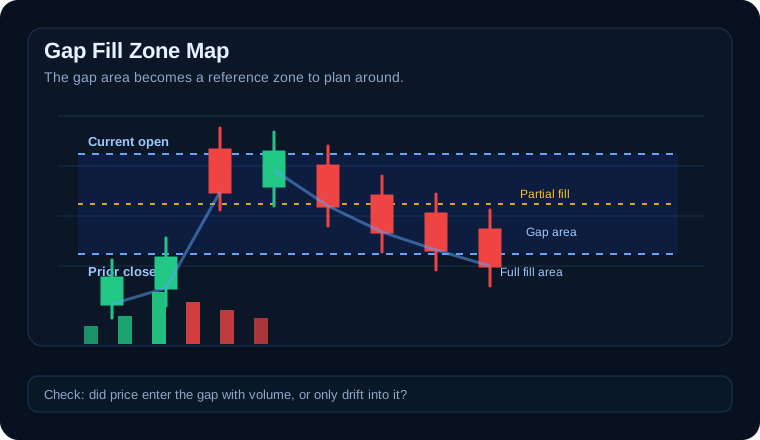
What A Gap Is
A gap is a space on the chart between where price traded in one session and where it opens or trades in the next session.
For example, if a stock closes at $4.00 and opens the next day at $5.25, there is a gap between $4.00 and $5.25.
That empty area becomes the gap zone.
A gap can happen because of:
- News
- Earnings
- SEC filings
- Analyst changes
- Sector movement
- Market-wide movement
- Overnight order flow
- Low liquidity
- A major change in attention
The reason for the gap matters. A gap caused by strong news may behave very differently from a gap caused by thin overnight trading.
What A Gap Fill Is
A gap fill happens when price moves back into the gap area.
If price fills the entire gap, it travels back through the full empty area.
If price only fills part of the gap, it moves into the gap but does not reach the other side.
Using the same example:
- Prior close: $4.00
- Current open: $5.25
- Gap area: $4.00 to $5.25
If price fades from $5.25 to $4.80, it has partially filled the gap.
If price fades all the way back to $4.00, it has fully filled the gap.
If price holds near $5.25 and keeps moving higher, the gap did not fill.
Important Gap Levels
A gap area usually has several levels worth marking.
Common gap levels include:
- Prior session close
- Current session open
- Gap top
- Gap bottom
- Gap midpoint
- Prior day high or low
- Premarket high or low
- Nearby support and resistance
- The level where price starts entering the gap
- The level where the fill attempt fails
The gap is not just one line. It is an area.
That area gives the trader a map for what price is trying to do.
Why Traders Watch Gap Fills
Traders watch gap fills because gaps can create unfinished chart space.
When price gaps up, some traders watch whether the stock can hold the new higher range. If it cannot, price may start moving back toward the prior close or prior range.
When price gaps down, some traders watch whether the stock can recover into the gap. If buyers step in, price may start filling the gap upward.
Gap fills can also attract attention because many traders watch the same prior close, gap top, and gap bottom levels.
But the gap itself does not force the move.
The trader still has to read volume, catalyst strength, support, resistance, liquidity, and how price behaves inside the gap.
The Catalyst Matters
The reason behind the gap is important.
A gap after meaningful news is different from a gap on no news. A gap after strong earnings is different from a gap caused by thin premarket prints. A gap after a major offering, merger update, FDA headline, or contract news may attract different types of traders.
Before trusting a gap fill idea, ask:
- What caused the gap?
- Was the catalyst strong or weak?
- Did volume support the gap?
- Is the stock holding the new range?
- Is the market treating the news as important?
- Did price reject the gap area or build above it?
A strong catalyst can keep price in a new range longer than expected.
A weak catalyst can fade quickly.
The gap area matters, but the reason for the gap helps explain why price may hold or fail.
Gap Up Behavior
A gap up happens when price opens above the prior close or prior range.
After a gap up, price can:
- Hold the gap and continue higher
- Pull back and partially fill the gap
- Fully fill the gap
- Reject from the gap top
- Lose the gap area and return to the prior range
- Chop inside the gap
For example, if a stock closes at $4.00 and opens at $5.25, the trader may watch whether $5.25 holds as the new area or whether price starts fading into the gap.
A gap up that holds above the open and builds may show acceptance of the new range.
A gap up that immediately loses the open and starts fading may bring the gap-fill area into play.
Gap Down Behavior
A gap down happens when price opens below the prior close or prior range.
After a gap down, price can:
- Stay weak and continue lower
- Start filling the gap upward
- Partially fill the gap and fail
- Reclaim the prior close
- Reject inside the gap
- Chop below the prior range
For example, if a stock closes at $8.00 and opens at $6.75, the trader may watch whether price can recover into the gap or whether sellers keep control below the prior range.
A gap down does not automatically mean price is cheap.
A gap down that cannot reclaim important levels may stay weak.
Failed Gap Fill
A failed gap fill happens when price starts moving into the gap but cannot keep filling it.
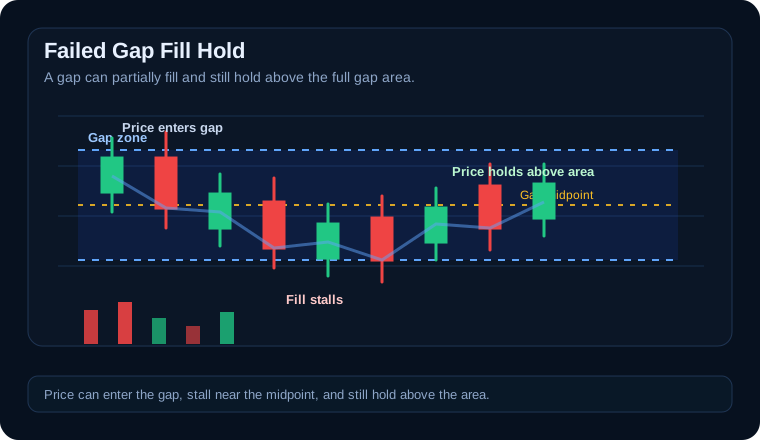
For example, price may gap up from $4.00 to $5.25, start fading into the gap, reach $4.70, then hold and bounce back above $5.00.
That would be a partial fill that failed to complete.
A failed gap fill may show:
- Price entered the gap.
- Volume faded during the fill attempt.
- Price held near the gap midpoint or another level.
- Buyers stepped back in before the gap fully filled.
- The gap area remained partly defended.
A failed gap fill does not mean the gap can never fill later. It means the first fill attempt did not finish.
Gap Fill Versus Gap Hold
A gap fill and a gap hold are opposite reads.
A gap fill means price moves back into the gap area.
A gap hold means price stays in the new range and does not give back much of the gap.
For a gap up:
- Gap fill means price fades back toward the prior close.
- Gap hold means price stays above the gap area and accepts the higher range.
For a gap down:
- Gap fill means price recovers upward into the gap.
- Gap hold means price stays below the prior range and remains weak.
The trader should know which one is happening instead of assuming all gaps behave the same way.
Realistic Example
A stock closes at $4.00 and opens the next day at $5.25 after news.
The gap area is roughly $4.00 to $5.25.
A trader may mark:
- $4.00 as the prior close
- $5.25 as the current open or gap top
- $4.60 as the rough midpoint
- Nearby support and resistance inside the gap
- The news catalyst that caused the move
A cleaner gap-hold read might show:
- Price holds near or above $5.25.
- Volume stays strong.
- Pullbacks remain controlled.
- The catalyst continues to attract attention.
A cleaner gap-fill read might show:
- Price loses the open.
- Volume fades after the initial gap.
- Price starts moving into the gap.
- Support inside the gap fails.
- Price keeps moving toward the prior close.
A failed gap-fill read might show:
- Price enters the gap.
- The fill stalls near the midpoint.
- Buyers step in.
- Price reclaims part of the gap area.
The gap gives the map. Price behavior tells the story.
Day Trading Versus Swing Trading Context
Gap fills can matter to day traders and swing traders, but the timeframe changes the read.
A day trader may watch whether a gap starts filling during the current session. This is especially common near the open when volume is high and traders are testing whether the gap will hold.
A swing trader may watch whether a gap fills over several days or weeks. Larger gaps can become multi-session support, resistance, or magnet areas.
The idea is the same. The timeframe changes the patience, risk, and level spacing.
What Beginners Usually Get Wrong
The biggest mistake is assuming all gaps must fill.
They do not.
Common mistakes include:
- Shorting a gap up only because it gapped
- Buying a gap down only because price looks cheaper
- Ignoring the catalyst that caused the gap
- Entering after most of the gap has already filled
- Ignoring volume during the fill attempt
- Ignoring support and resistance inside the gap
- Treating a partial fill as failure or success too quickly
- Forgetting that strong news can keep price in the new range
- Drawing the gap levels only after the move is over
A gap should help create a map. It should not create an assumption.
What To Watch Around A Gap
When price approaches a gap area, watch how it behaves around the gap levels.
Ask:
- Was it a gap up or a gap down?
- What caused the gap?
- Where is the gap top?
- Where is the gap bottom?
- Where is the prior close?
- Did price enter the gap with volume?
- Did price hold, partially fill, fully fill, or fail inside the gap?
- Is price near support or resistance inside the gap?
- Is the trade idea early, late, or already crowded?
The gap area is the reference. The reaction inside the gap is the lesson.
How This Helps When Studying Charts Or Trades
Gap fill lessons help traders study whether they read the gap or assumed the gap had to close.
When looking back at a chart or completed trade, ask:
- What caused the gap?
- Were the gap levels marked before the trade?
- Did price hold the gap or start filling it?
- Did the fill complete or fail partway through?
- Was volume supporting the fill attempt?
- Was the decision made near a gap level or after most of the move was done?
- Did the trader respect the level where the fill failed?
This keeps gap fills practical. The goal is not to predict that every gap closes. The goal is to understand how price behaves around the gap area.
Key Takeaway
A gap fill happens when price moves back into a gap area, but gaps do not have to fill.
The useful read comes from the gap levels, the catalyst, volume, support and resistance inside the gap, and whether price holds, partially fills, fully fills, or fails inside the area.
Do not assume the gap closes. Read the gap area.
Related Lessons
- Consolidation
- Support and Resistance
- Previous Day High Low
- Premarket High Low
- Volume
- Stock Catalysts
FAQ
What is gap fill trading?
Gap fill trading focuses on price moving back through part or all of a gap area left between trading sessions.
Do all stock gaps fill?
No. Some gaps fill quickly, some fill later, some partially fill, and some do not fill at all.
What levels matter in a gap fill?
Common levels include the prior close, current open, gap top, gap bottom, gap midpoint, and nearby support or resistance.
Why does the gap catalyst matter?
The catalyst helps explain why the gap happened. Strong news can help a gap hold, while weak or thin gaps may fade more easily.
What is a failed gap fill?
A failed gap fill happens when price starts moving into the gap but stalls before filling it completely and then moves away from the gap area.
What should beginners watch around gap fills?
Beginners should watch the gap levels, the catalyst, volume, whether price holds or enters the gap, and whether the fill completes, partially fills, or fails.