
Track your progress
To save this lesson to your Academy progress, join the free TradersLink Discord and log in with your Discord account.
Log in with DiscordDescending Triangle Pattern
Best suited for: day trading and swing trading.
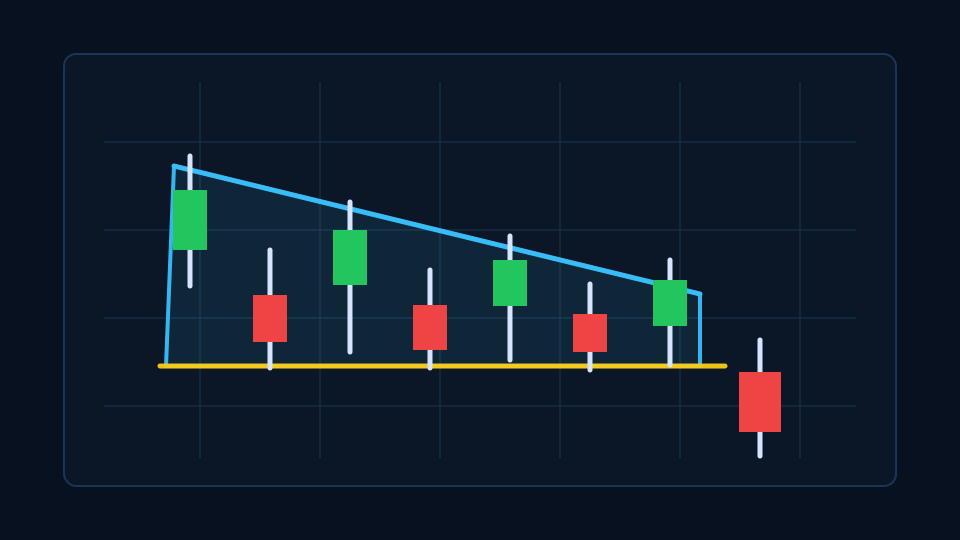
A descending triangle forms when price repeatedly tests a similar support area while making lower highs above it. The pattern shows pressure building against support, but the support area still needs to be tested and reviewed.
The pattern is most useful when support is clear, the lower highs are obvious, and traders can see exactly where the pressure read would change.
What It Is
A descending triangle combines a flat support area with lower highs.
- Repeated support tests.
- Lower highs pressing toward support.
- Tightening range.
- A breakdown attempt or failed breakdown.
- A reclaim area that can change the read.
The pattern is cleaner when support and lower highs are visible before the move, not only after the chart is marked up.
Pattern Structure
The lower highs show sellers stepping down. The flat support area shows buyers still defending a zone. The next review is whether support breaks with follow-through, holds again, or reclaims after a failed break.
A useful descending triangle should have enough touches to define the structure, but not so many messy swings that the level becomes noise.
Clean Vs Forced Versions
A clean version has repeated support tests, lower highs, and a tightening range.
A forced version appears when the support area is uneven, the lower highs are not clear, or the chart is simply chopping sideways. If the pattern needs too many lines to explain, it may not be a clean pattern.
Context That Matters
Descending triangles need support and volume context.
- Quality of the support area.
- Strength of each bounce from support.
- Volume during the compression.
- Nearby larger-timeframe levels.
- Liquidity and spread.
- Whether a failed breakdown reclaims the range.
When It Can Mislead
Descending triangles mislead when traders assume repeated support tests mean support must break. Support can hold, reclaim, or turn into a wider range.
Example Chart Read
A stock tests the same support zone three times while each bounce becomes weaker. Volume rises on the latest test, but price quickly reclaims the support area. The next read is whether the breakdown follows through or whether the reclaim changes the structure.
Common Mistakes
One common mistake is drawing the triangle before the lower highs are clear.
Another mistake is ignoring a strong reclaim after support breaks.
Traders also make mistakes when they enter far from the failure area.
Another mistake is treating every flat support level as a descending triangle.
A final mistake is forgetting to check nearby support below the pattern.
Related Lessons
Key Takeaway
A descending triangle is repeated support plus lower highs. The useful read is whether pressure, volume, and follow-through support that structure or weaken it.
FAQ
What is a descending triangle?
It is a pattern where price tests a similar support area while lower highs form above it.
What makes it cleaner?
Clear support, lower highs, tighter price action, volume context, and a visible reclaim or failure area.
Why can it fail?
It can fail when support holds, volume fades, a breakdown reclaims, or the pattern was forced onto choppy price action.
Is every flat support level a descending triangle?
No. The lower highs and tightening pressure matter.