
Track your progress
To save this lesson to your Academy progress, join the free TradersLink Discord and log in with your Discord account.
Log in with DiscordBull Flag Pattern
Best suited for: day trading and momentum swing trading.
A bull flag is a pattern traders watch after a strong upward move followed by a controlled pullback or consolidation. It can show that price is pausing instead of giving back the entire move.
A bull flag can also fail quickly, especially when the entry is late or the stock is already extended.
What It Is
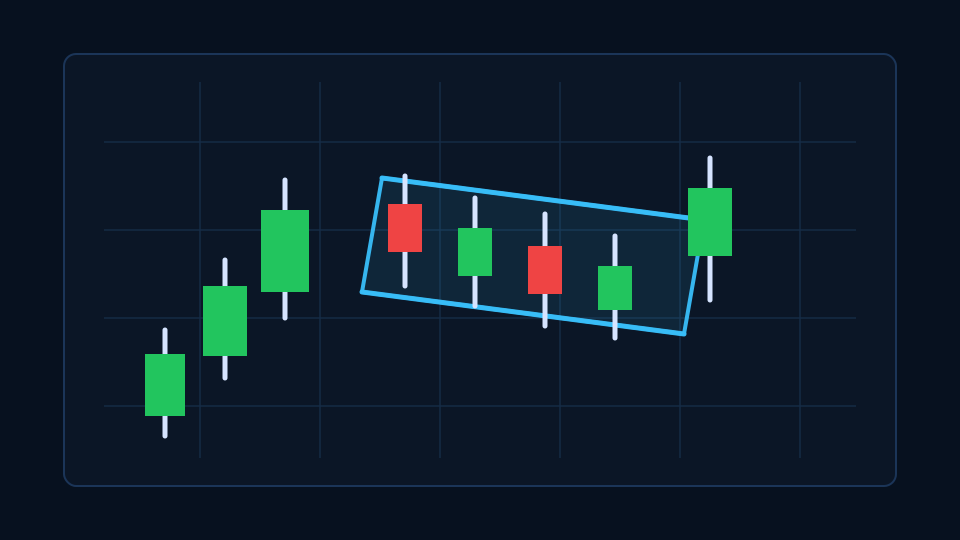
A bull flag is a continuation-context pattern made from an initial move, a controlled pause, and a level where the idea can hold or fail.
- A strong initial move often called the flagpole.
- A pullback or sideways consolidation.
- A support or higher-low area inside the flag.
- Volume often cools during the pause.
- A later break or failure needs review.
The next review is whether the pullback holds its structure or turns into a failed pattern.
Pattern Structure
A bull flag is useful only when the structure creates a clear area where the idea can be wrong.
- An initial move with real participation.
- Controlled pullback instead of panic selling.
- Higher lows or support inside the flag.
- A clear upper flag area where pressure is being tested.
- A lower flag or support area where the pattern would fail.
- Volume review on the move, the pause, and any attempted continuation.
What Makes A Bull Flag Clean
A cleaner bull flag usually has a strong first move, then a pause that stays orderly. The pullback should not erase most of the original move. The candles inside the flag should look controlled rather than panicked, and the risk area should be close enough that the trade can be reviewed honestly.
Volume often expands on the first move and cools during the pause. That helps separate a controlled reset from a messy stall.
What Makes A Bull Flag Forced
A forced bull flag is usually just a label placed on a chart after a trader already wants to be involved.
- The stock is already extended far from support.
- The pullback is wide, sloppy, or full of failed pushes.
- The pattern is forming directly under major resistance.
- The entry would be far from any reasonable invalidation area.
- The trader is reacting to the pattern name instead of the structure.
Context That Matters
Bull flag context should answer whether the pause is healthy or just a late-stage stall.
- Extension from the original move.
- Nearby resistance.
- Volume on the move and pullback.
- Catalyst quality.
- Spread and liquidity.
- Distance from support to entry.
Entry And Risk Concept
A useful bull flag should have a defined area where the pattern has failed. If the only reason for the trade is that price is already moving, the review will often show a chase rather than a structured decision.
For review purposes, compare the entry location with the flag support area, nearby resistance, spread, and expected slippage. A pattern that looks clean on a screenshot can still be poor if the risk was too wide or the entry came after the clean area had passed.
When It Can Mislead
Bull flags mislead when traders chase after the break, ignore extension, or call any pullback after a green candle a flag. They also mislead when the first move was thin, the pullback was not controlled, or the attempted continuation runs straight into resistance.
Example Chart Read
A stock gaps up on news, moves sharply higher, then pulls back in a tight range while holding above VWAP. The useful read is whether the pullback stayed controlled, whether volume supported the next attempt, and where the flag stopped working.
Common Mistakes
One common mistake is forcing a flag after any upward move.
Another mistake is chasing after the attempted break is already extended.
Traders also make mistakes when they ignore nearby resistance.
Another mistake is using volume alone instead of reviewing price behavior around the flag.
A final mistake is holding after the flag loses its support area.
Related Lessons
- Chart Patterns
- Bear Flag Pattern
- Pullbacks And Dip-Buy Setups
- Volume
- Chasing Stocks
- Risk Management
Key Takeaway
The pattern name matters less than whether the structure was visible, reviewable, and tied to clear levels, volume, and risk.
FAQ
What is a bull flag?
It is a strong move followed by a controlled pullback or consolidation.
What weakens a bull flag?
A bull flag weakens when the pullback loses structure, price gets too extended, volume fades on the next attempt, or nearby resistance stops the move.
What makes it cleaner?
Controlled pullback, clear risk, volume context, and room before resistance.
Why do bull flags fail?
They fail when price is extended, volume fades, resistance holds, or the flag support breaks.
How should it be reviewed?
Review initial move, pullback quality, volume, entry timing, risk, and failure.
What else should a bull flag be compared with?
Compare the flag with nearby support, nearby resistance, volume during the pause, and whether the entry is still close to the area that would prove the read wrong.