
Track your progress
To save this lesson to your Academy progress, join the free TradersLink Discord and log in with your Discord account.
Log in with DiscordResistance Levels: How Traders Read Price Running Into Trouble
A resistance level is an area where price has struggled before.
It may be a prior high, the top of a range, a premarket high, a previous day high, or a former support area that price broke below and later failed to reclaim.
The key idea is simple: resistance is an area where buying pressure slowed down before and sellers were strong enough to create a reaction.
That does not mean resistance has to reject price again. It means the area is worth watching because price has already shown that traders cared about it.
Resistance is useful because it helps answer three basic questions:
- Where is price compared with a prior supply area?
- Is the move pushing into a place where it has failed before?
- What would price need to do to prove the level is no longer resistance?
What A Resistance Level Shows
Resistance shows that price found pressure around an area before.
Sometimes that pressure comes from traders taking profit. Sometimes it comes from sellers entering. Sometimes it comes from trapped buyers selling near their old entry. Sometimes it comes from traders watching the same prior high or range top.
You do not need to know every reason behind the reaction. The first job is to recognize that price reacted there.
A resistance level can come from:
- A prior intraday high
- Premarket high
- Previous day high
- High of day
- A failed breakout area
- The top of a consolidation range
- A major swing high
- A former support area that later rejected price
- A daily chart reaction area
Resistance becomes more useful when it is clear before the decision, not only obvious after the move.
Resistance Is Not Just A Rejection Area
Many beginners think of resistance as a place where price is supposed to reject.
That is too simple.
A resistance level can do several things:
- Price can reject cleanly.
- Price can pause and move sideways under the level.
- Price can test the area again and again.
- Price can break above it.
- Price can break above it and fail back under.
- Price can break above it and later hold it as support.
The reaction is the important part.
When price reaches resistance, the lesson is not “sell resistance.” The lesson is to watch how price behaves there. Does the move stall? Does volume fade? Does price build below the level? Does it break and hold? Does it break and fail?
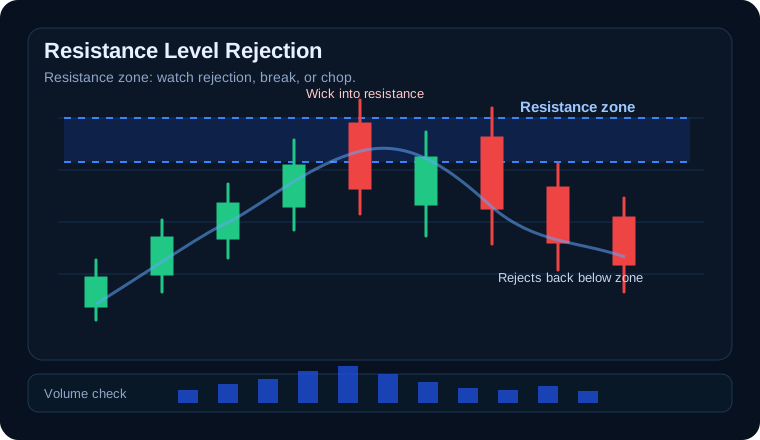
A Clean Resistance Rejection
A cleaner resistance rejection usually has a few things going for it.
Price reaches an area that was already visible. The reaction is clear. The rejection does not need to be dramatic, but it should show that the area mattered. Ideally, the trader can also see what price would need to do to change the read.
For example, imagine a stock pushes from $3.20 to $3.85, pulls back, then later tries to push through $3.85 again. Price wicks above the area, cannot hold, and closes back below it.
That area may still be acting as resistance.
A beginner should ask:
- Was the resistance area visible before the rejection?
- Did price fail near the same general zone more than once?
- Was volume increasing, fading, or mixed near the test?
- Was the stock already extended from support?
- Did price close above the zone or back below it?
- What would show that resistance is no longer holding?
A resistance rejection is easier to understand when the breakout area is clear. If the trader cannot explain what a clean break would look like, the level may not be useful enough.
Weak Resistance
Not every resistance reaction is strong.
Sometimes price reaches resistance and pulls back only a little. Then it comes back again. Then it starts forming higher lows underneath the level. That can show that sellers are having a harder time pushing price away.
Weak resistance may show up as:
- Smaller pullbacks after each rejection
- Higher lows forming below resistance
- Volume increasing into repeated tests
- More time spent holding near the level
- Tight candles building under resistance
- A quick reclaim after a failed break
Weak resistance does not automatically mean price will break out. It simply means the level is not rejecting price as strongly as it did before.
This is an important beginner lesson. A stock can still be “at resistance” while the chart is getting stronger underneath it.
When Resistance Breaks
A resistance break happens when price moves above a resistance area and starts trading above it.
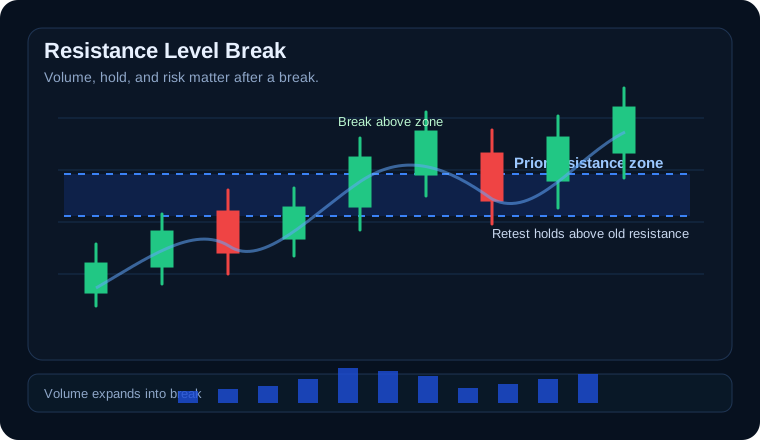
The break matters because the area that used to stop price is no longer behaving the same way.
After resistance breaks, a trader should look at what happens next:
- Does price hold above the level?
- Does price fall back under the resistance zone?
- Does volume increase during the break?
- Does the old resistance area become support on a pullback?
- Were higher lows already building under the level before the break?
A resistance break can change the chart. If a trade idea depends on price clearing a level, the behavior after the break is important information.
The mistake beginners often make is treating the first move above resistance as the whole story. The break matters, but the hold matters too.
When A Breakout Fails
A failed breakout happens when price moves above resistance, then falls back below the area instead of holding above it.
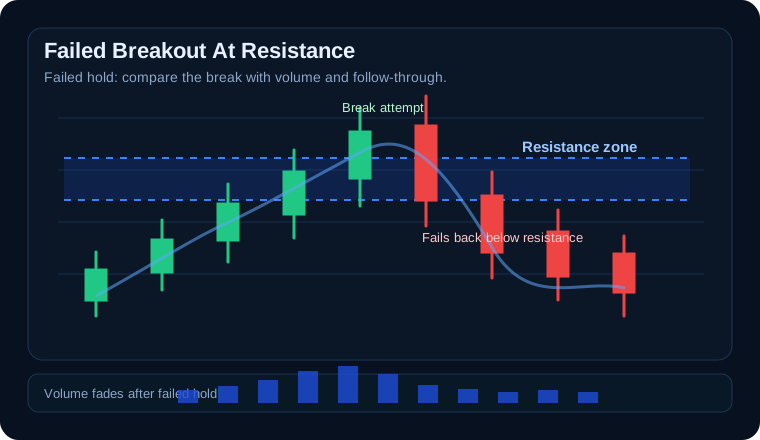
A failed breakout can happen quickly. Price clears the level, traders chase the move, volume fades, and price slips back under the same area that looked exciting a few candles earlier.
The useful question is not just whether price broke resistance. The useful question is whether price could stay above it.
A failed breakout often has:
- A clear resistance area before the move
- A push above resistance
- Weak follow-through after the break
- A move back under the level
- Traders stuck with entries above the breakout area
If price breaks resistance for one candle and immediately loses it, the breakout may not mean much yet.
Resistance Becoming Support
Broken resistance can later become support.
This happens when price breaks above a resistance area, trades above it, then pulls back and holds near that same area. Traders who missed the breakout may buy the pullback. Other traders may view the old resistance zone as the new area price needs to defend.
For example, if $5.00 was resistance all morning and price finally breaks above it, a later pullback into $5.00 may become a test. If price holds there, the old resistance is now acting more like support.
This is why resistance breaks matter. The level does not disappear. Its role can change.
Realistic Example
A stock gaps up after news and opens near $4.00. It pushes to $4.80, rejects, pulls back, then later pushes toward $4.80 again.
A trader may mark $4.75 to $4.85 as resistance.
Later, price comes back to that area for another test. This is where the chart becomes more interesting.
A strong breakout read might show:
- Price holds higher lows under resistance.
- Volume increases into the test.
- Price clears the zone and stays above it.
- The old resistance holds on a pullback.
A weak breakout read might show:
- Price spikes above the zone and immediately fails.
- Volume fades after the break.
- Price closes back below resistance.
- The trader entered far above the level after the move was already extended.
The resistance label is not enough. The behavior around the level is what matters.
Day Trading Versus Swing Trading Context
Resistance levels matter in both day trading and swing trading, but the source of resistance may be different.
A day trader may watch:
- Premarket high
- High of day
- Previous day high
- Opening range high
- VWAP area
- Intraday swing highs
- Former intraday support that becomes resistance
A swing trader may watch:
- Daily chart resistance
- Multi-day highs
- Prior breakdown zones
- Larger consolidation highs
- Weekly resistance areas
- Gap resistance areas
The same principle applies: price has reacted there before, so the area may matter again.
The difference is the timeframe. A resistance level that matters for a five-minute day trade may not matter much for a multi-day swing. A daily resistance area may matter even if the intraday chart looks strong.
What Beginners Usually Get Wrong
The biggest mistake is treating resistance like a wall that price cannot pass.
Resistance is not a wall. It is an area to watch.
Common mistakes include:
- Buying just because price broke above resistance for one candle
- Chasing far above the breakout area
- Ignoring nearby resistance after a fast move
- Assuming resistance must reject because it rejected before
- Treating one exact price as the whole resistance zone
- Ignoring higher lows building under resistance
- Ignoring volume after the breakout
- Holding through a failed breakout without a plan
- Forgetting that broken resistance can become support
- Drawing resistance after the trade to justify a late entry
A resistance level should make the chart easier to understand. It should not become a reason to chase or freeze.
What To Watch At Resistance
When price reaches resistance, focus on the reaction.
Ask:
- Does price reject cleanly or barely pull back?
- Are pullbacks getting smaller?
- Is volume increasing or fading?
- Are higher lows building under the level?
- Does price break above and hold?
- Does price break above and fail back under?
- Is the resistance area still relevant on the timeframe being traded?
The more clearly price reacts, the more useful the level becomes. The messier the reaction, the more careful a trader should be about giving the level too much weight.
How This Helps When Studying Charts Or Trades
Resistance levels help traders study whether a decision happened in a good location.
A trade taken directly into resistance is different from a trade planned near a breakout level. A breakout that holds above resistance is different from a breakout that fails back under. A late entry after a stock is already extended is different from an entry planned near a clear level.
When looking back at a chart or completed trade, ask:
- Was the resistance level visible before the decision?
- Did price actually reject, break, or hold the area?
- Did the reaction get stronger or weaker?
- Did the breakout fail before the trade idea changed?
- Did old resistance become support later?
- Was the level useful, or was it forced onto the chart afterward?
This is how resistance becomes useful as a learning tool. It helps the trader understand whether the chart gave a clear area to work with.
Key Takeaway
A resistance level is an area where price has struggled before, but the label is only the starting point.
What matters is how price behaves when it returns to that area. Resistance can reject, weaken, break, fail, or become support later.
Do not read resistance as an automatic rejection. Read the reaction.
Related Lessons
- Support and Resistance
- How to Draw Support and Resistance
- Support Levels
- Key Levels Trading
- Breakout Trading
- Level Reclaim
FAQ
What is a resistance level?
A resistance level is a price area where price has struggled before or where sellers previously appeared strongly enough to create a reaction.
Does resistance mean price will reject?
No. Resistance means the area is worth watching. Price can reject, pause, break, fail, or turn the old resistance into support.
What makes resistance stronger?
Resistance is usually more useful when the area is clear, visible before the decision, tied to real reactions, and still relevant to the current timeframe.
What does it mean when resistance breaks?
It means price has moved above an area that previously stopped it. The next question is whether price holds above the level or fails back under it.
Can resistance become support?
Yes. After resistance breaks, price may later pull back to the same area and hold there.
What should beginners watch at resistance?
Beginners should watch the reaction: whether price rejects, builds below the level, breaks and holds, or breaks and quickly fails.