
Track your progress
To save this lesson to your Academy progress, join the free TradersLink Discord and log in with your Discord account.
Log in with DiscordPivot Levels: How Traders Read Chart Turning Points
A pivot level is an area where price clearly turned, paused, rejected, bounced, or shifted direction.
It is a visible chart reference point.
A pivot can come from a swing high, swing low, support zone, resistance zone, breakout area, failed breakout area, range high, range low, or session level.
The word “pivot” can mean different things in trading. Some traders use calculated pivot points from formulas. In this course, pivot levels mean practical chart turning points that help a trader understand where price has changed direction before.
The goal is not to add more lines to the chart. The goal is to notice the turning points that actually help explain the move.
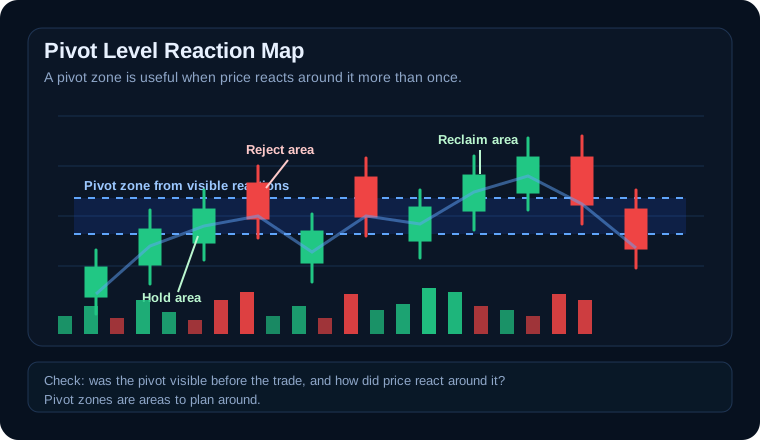
What A Pivot Level Is
A pivot level is a price area where the chart gave a clear reaction.
Price may have bounced from the area. It may have rejected from it. It may have broken through it and later retested it. It may have failed to reclaim it. It may have used the area as a turning point more than once.
A pivot level can come from:
- A swing high
- A swing low
- Prior support
- Prior resistance
- A breakout level
- A breakdown level
- A reclaim level
- A failed breakout area
- A failed breakdown area
- A range high or range low
- Previous day high or low
- Premarket high or low
A pivot level is useful when it helps explain where price changed behavior.
Pivot Levels Versus Calculated Pivot Points
This part matters because the word “pivot” can confuse beginners.
Some traders use calculated pivot points. Those are formula-based levels created from prior session prices, often using the prior high, low, and close.
This lesson is about chart pivot levels.
A chart pivot level is not created by a formula. It comes from visible price action. It is an area where price turned, reacted, or changed behavior enough that traders may want it on the chart.
Both ideas can exist, but they are not the same thing.
For this course, when we say pivot level, think:
A useful chart turning point.
Why Pivot Levels Matter
Pivot levels help traders connect structure with location.
Support and resistance tell the trader where price has held or struggled. Swing highs and swing lows show turning points. Key levels help build a cleaner map. Pivot levels bring those ideas together around the areas where price actually shifted.
A pivot level can help answer:
- Where did price turn before?
- Is price returning to a meaningful reaction area?
- Did price reclaim a level it had lost?
- Did price reject at a prior turn?
- Is the trader reacting near a useful area or in the middle of noise?
- Did the chart change behavior around this level?
A good pivot level makes the chart easier to explain.
A bad pivot level is just another line.
A Clean Pivot Level
A clean pivot level is usually easy to see.
Price reacts there in a way that changes the chart. The reaction may be a bounce, rejection, breakout, breakdown, reclaim, or failed reclaim.
A clean pivot may show:
- A clear swing high or swing low
- Multiple reactions near the same area
- A breakout that later retests the area
- A failed breakout that creates a rejection point
- A support area that becomes resistance
- A resistance area that becomes support
The level should be useful before the decision, not only after the chart has already moved.
A beginner should ask:
Would this pivot still matter if I stepped back from the chart?
If the answer is no, it may be a small wiggle rather than a useful pivot.
Pivot Levels And Support/Resistance
Pivot levels often become support or resistance.
A swing low pivot can become support if price returns to that area and holds. A swing high pivot can become resistance if price returns to that area and rejects.
A breakout pivot can become support if price breaks above it and later holds the retest. A breakdown pivot can become resistance if price loses it and later rejects from underneath.
This is why pivot levels are useful. They show where price has already changed behavior, and those areas can become important again.
The pivot does not need to be perfect. It needs to be meaningful enough to help explain the chart.
When A Pivot Fails
A pivot fails when price tries to use the area again but cannot hold or reclaim it.
For example, price may break below a pivot, bounce back into it, and reject. Or price may reclaim a pivot for one candle and then immediately fall back below it.
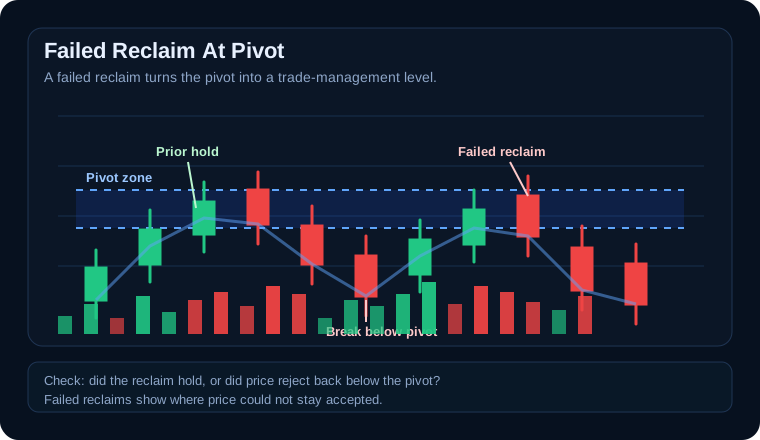
A failed pivot can be useful because it shows that the area still matters, but not in the way the trader may have hoped.
A failed reclaim at a pivot may show:
- Price lost the pivot first.
- Price tried to reclaim it.
- The reclaim could not hold.
- Price rejected back below the area.
- The pivot became a decision point again.
The level is doing its job if it helps the trader understand what changed.
Realistic Example
A stock opens near $2.40 and runs to $2.95.
After the first push, it pulls back to $2.62 and bounces. Later, price pushes back toward $2.95.
A trader may mark two pivot areas:
- $2.90 to $2.95 as a resistance pivot from the morning high
- $2.60 to $2.65 as a support pivot from the pullback low
Now the chart has two useful turning areas.
If price breaks above $2.95 and holds, that pivot may become a breakout reference. If price breaks above $2.95 and fails back under it, that pivot may become a failed breakout area. If price loses $2.60 to $2.65, the earlier support pivot has failed.
The same pivot can tell different stories depending on how price behaves around it.
Pivot Levels In Day Trading And Swing Trading
Pivot levels can matter on any timeframe.
A day trader may watch pivots from:
- Premarket high
- Premarket low
- High of day
- Low of day
- Opening range high or low
- Intraday swing highs and lows
- Failed breakout or reclaim areas
A swing trader may watch pivots from:
- Daily swing highs
- Daily swing lows
- Multi-day support and resistance
- Prior breakout zones
- Prior breakdown zones
- Gap areas
- Larger range highs and lows
The timeframe should match the trade being studied.
A tiny intraday pivot may help with a quick day trade but may not matter for a swing trade. A daily pivot may matter for a swing trade but may be too far away to manage a fast intraday decision.
Do Not Mark Every Turn
The biggest mistake with pivot levels is marking too many of them.
If every small turn becomes a pivot, the chart becomes crowded. When the chart is crowded, the levels stop helping.
A useful pivot should have a reason to be marked.
It should answer at least one of these questions:
- Did price clearly turn there?
- Did the area become support or resistance?
- Did price break, reclaim, or reject there?
- Does this level affect the current trade idea?
- Would this area matter if price returns to it?
If the pivot does not help answer a real chart question, it may not belong on the active map.
What Beginners Usually Get Wrong
Common mistakes include:
- Marking every small candle turn as a pivot
- Treating pivots as exact prices instead of zones
- Ignoring timeframe
- Drawing pivots only after the trade is over
- Using pivots that do not affect the current move
- Treating a pivot as an automatic bounce or rejection area
- Ignoring volume, spread, and liquidity around the pivot
- Moving a pivot after entry to make the trade look better
A pivot level should clarify the chart. If it creates more confusion, remove it.
What To Watch Around A Pivot
When price returns to a pivot level, watch the reaction.
Ask:
- Does price hold the pivot?
- Does price reject from the pivot?
- Does price break through it?
- Does price reclaim it after losing it?
- Does price fail to reclaim it?
- Is volume meaningful around the reaction?
- Is the pivot still relevant to the current timeframe?
- Is price near the pivot or already extended away from it?
The pivot is the reference point. The behavior around it is the lesson.
How This Helps When Studying Charts Or Trades
Pivot levels help traders study where the chart actually turned.
When looking back at a chart or completed trade, ask:
- Was the pivot visible before the move?
- What created the pivot?
- Did price respect the area later?
- Did the pivot act like support or resistance?
- Did price reclaim or fail to reclaim the pivot?
- Was the decision made near the pivot or far away from it?
- Did the trader force the pivot after the trade?
This keeps pivot levels useful. The goal is not to decorate the chart. The goal is to identify the turning points that explain price behavior.
Key Takeaway
Pivot levels are useful chart turning points.
They can come from swing highs, swing lows, support, resistance, breakouts, breakdowns, failed moves, or session levels. The best pivots are clear, visible before the decision, and helpful for understanding how price behaves when it returns to the area.
Do not mark every turn. Mark the turns that matter.
Related Lessons
- Support and Resistance
- Swing Highs and Swing Lows
- Key Levels Trading
- Resistance Levels
- Support Levels
- Previous Day High Low
- Premarket High Low
FAQ
What are pivot levels in trading?
Pivot levels are chart areas where price has clearly turned, paused, bounced, rejected, broken, reclaimed, or shifted behavior.
Are pivot levels the same as calculated pivot points?
Not always. Calculated pivot points come from formulas. This lesson focuses on visible chart pivot levels created by price action.
Are pivot levels support and resistance?
They can be. A pivot level can become support or resistance if price reacts around it clearly enough.
What makes a pivot level useful?
A useful pivot level is visible before the decision, tied to a clear chart reaction, and helpful for understanding price location or structure.
Should pivot levels be exact lines?
Usually, no. Like support and resistance, pivot levels often work better as zones.
What should beginners watch around pivot levels?
Beginners should watch whether price holds, breaks, reclaims, rejects, or ignores the pivot area.