
Track your progress
To save this lesson to your Academy progress, join the free TradersLink Discord and log in with your Discord account.
Log in with DiscordHigher Highs and Higher Lows: How Traders Read Rising Structure
Higher highs and higher lows describe a chart that is making upward progress.
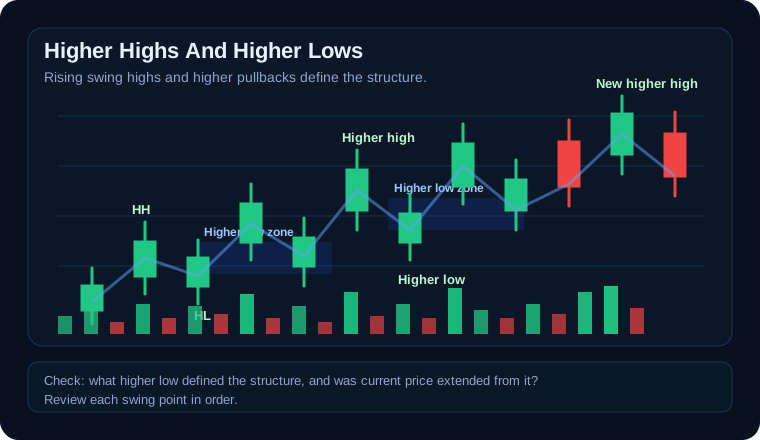
A higher high forms when price pushes above a prior swing high. A higher low forms when price pulls back but holds above the prior swing low.
Together, they create rising structure.
This matters because a new trader should not read every green candle the same way. A stock that is making higher highs and holding higher lows is behaving differently from a stock that is only spiking once and fading back into the range.
The structure tells a story:
- Buyers are pushing price into higher areas.
- Pullbacks are holding above prior lows.
- The chart is still building upward until that sequence weakens.
What A Higher High Is
A higher high forms when price pushes above the prior swing high.
It shows that price reached a new higher area compared with the previous push.
For example, if a stock pushes to $2.40, pulls back, then later pushes to $2.75, the $2.75 area is a higher high compared with $2.40.
A higher high can show progress, but it should still be read with the rest of the chart. If price makes a new high but immediately rejects into resistance, that higher high may not be as strong as it first looks.
The high itself is only part of the read. What price does after making the higher high matters too.
What A Higher Low Is
A higher low forms when price pulls back but holds above the prior swing low.
This is often more useful than the new high because it shows where buyers defended the pullback.
For example, if a stock pulls back to $2.20, later rallies, then pulls back again and holds $2.45, the $2.45 area is a higher low.
That higher low tells the trader something important: sellers pushed price down, but they could not push it as low as before.
Higher lows often become the structure points traders watch most closely. If the latest higher low fails, the rising structure may be changing.
Why Higher Lows Often Matter More Than Higher Highs
New highs get attention. Higher lows often tell the better story.
A higher high shows that price reached a new area. A higher low shows whether the pullback stayed controlled after that push.
That matters because a chart can make a new high and still be risky if price is extended or running straight into resistance. But if price pulls back, holds a higher area, and then turns back up, the structure becomes easier to read.
A higher low can help answer:
- Where did buyers step back in?
- Is the pullback controlled or messy?
- What area is the structure depending on?
- Is the trader entering near structure or chasing far above it?
- What level would weaken the uptrend if it failed?
This is why many structure reads focus on the pullbacks, not only the breakouts.
How Rising Structure Forms
Higher-high and higher-low structure usually forms in a sequence:
- Price pushes up from a swing low.
- Price creates a swing high.
- Price pulls back.
- The pullback holds above the prior swing low.
- Price turns up from that higher low.
- Price pushes above the prior swing high.
- The next pullback is watched to see whether it forms another higher low.
That sequence is what gives the chart its rising structure.
The structure stays cleaner while price keeps making progress and defending higher pullbacks. It starts to weaken when price fails to make a meaningful new high, loses the latest higher low, or starts forming lower highs.
Realistic Example
A stock moves from $2.00 to $2.42, then pulls back to $2.24.
Later, it pushes to $2.76, then pulls back to $2.50.
Then it pushes again to $3.05.
A trader might read the structure like this:
- Swing high near $2.42
- Swing low near $2.24
- Higher high near $2.76
- Higher low near $2.50
- Higher high near $3.05
That sequence shows upward progress so far.
But the structure depends on the pullbacks holding. If price later loses $2.50, cannot reclaim it, and starts making lower highs, the chart no longer reads the same way.
The mistake is calling the chart an uptrend only because it was rising earlier. Structure has to keep proving itself.
Clean Rising Structure Versus A Choppy Move
Clean rising structure is usually easy to explain.
Price makes a swing high, pulls back, holds a higher low, then pushes into a higher high. The pullbacks are not random. They hold above areas that make sense.
A choppy move is different.
Price may spike, drop, spike again, fade back, and move sideways without clear swing points. A beginner may try to label that as higher highs and higher lows, but the structure may not be clean enough to help.
A clean structure helps the trader understand the chart.
A forced structure gives the trader an excuse to see strength that is not really there.
Extension Risk
A chart can have rising structure and still be a poor location for a new entry.
This happens when price is already far above the latest higher low or pushing directly into a major resistance area.
Extension risk can show up when:
- Price is far from the latest higher low.
- Price has made several pushes without a controlled pullback.
- Volume is fading on later highs.
- Candles are getting wider and less controlled.
- Price is approaching a known resistance zone.
- The trader is reacting late instead of planning near structure.
This is important. A chart can be strong and still be too extended for a clean decision.
A beginner should learn to separate structure strength from entry location.
When A Higher Low Fails
A higher low fails when price loses the latest meaningful higher-low area and cannot recover it.
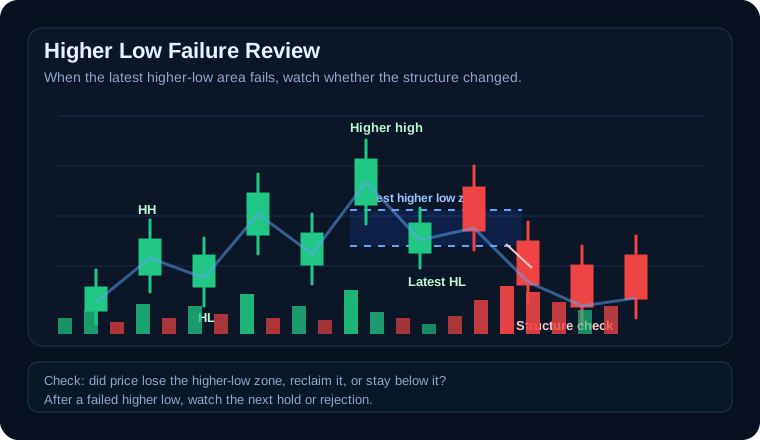
That failure can change the structure because the pullback that was supposed to hold did not hold.
A higher low failure does not mean price has to collapse. It means the chart no longer has the same rising structure it had before.
After a higher low fails, watch:
- Did price lose the level cleanly or only wick below it?
- Did price reclaim the higher-low area quickly?
- Did volume expand on the loss of the level?
- Did price start forming lower highs afterward?
- Was the failure on the timeframe that mattered?
The key idea is simple: if the trade idea depended on a higher low holding, that level matters.
Day Trading Versus Swing Trading Context
Higher highs and higher lows can appear on any timeframe.
A day trader may watch them on a one-minute, five-minute, or fifteen-minute chart to see whether intraday structure is building.
A swing trader may watch them on the daily chart to see whether a stock is building a multi-day uptrend.
The structure should match the trade style.
A five-minute higher low may help a day trader manage an intraday idea, but it may not matter much for a swing trade. A daily higher low may matter for a swing trader, but it may be too far away to help with a fast scalp.
Name the timeframe before trusting the structure.
What Beginners Usually Get Wrong
The most common mistake is thinking higher highs and higher lows mean the next move is automatic.
They do not.
They show structure. The trader still has to read location, volume, resistance, risk, and whether the latest pullback actually held.
Common mistakes include:
- Calling every green move an uptrend
- Treating one higher low as a full trend
- Buying far above the latest higher low
- Ignoring resistance above the move
- Ignoring volume fading into new highs
- Holding after the higher low that mattered has failed
- Mixing timeframes without knowing which one matters
- Drawing the structure only after the trade is over
Higher-high and higher-low structure should make the chart clearer. If it becomes a reason to chase, it is being used poorly.
What To Watch As The Structure Develops
As rising structure develops, pay attention to the pullbacks.
Ask:
- Is each new high meaningfully higher than the last one?
- Are pullbacks holding above prior swing lows?
- Are higher lows forming near useful support areas?
- Is volume improving or fading on the pushes?
- Is price getting extended away from the latest higher low?
- What level would weaken the structure if lost?
- Is price running into major resistance?
The best reads usually come from combining structure with levels.
Higher highs show progress. Higher lows show whether buyers are still defending that progress.
How This Helps When Studying Charts Or Trades
Higher highs and higher lows help traders study whether a decision lined up with rising structure.
For example, an entry near a controlled higher low is different from an entry after price has already pushed far above the latest support area. Holding while the latest higher low is intact is different from holding after that level has failed.
When looking back at a chart or completed trade, ask:
- What was the most important higher low?
- Was the entry near structure or far above it?
- Was price pushing into resistance?
- Did the structure keep building after entry?
- Did the higher low fail before the trader adjusted?
- Was the structure clear before the decision, or only after the move?
This keeps the lesson practical. The point is not to label the chart perfectly. The point is to understand whether price was still making upward progress when the decision was made.
Key Takeaway
Higher highs and higher lows show rising market structure.
The higher highs show that price is reaching new areas. The higher lows show whether buyers are still defending pullbacks.
Do not chase the label. Watch the sequence, the pullbacks, the nearby levels, and the point where the structure starts to weaken.
Related Lessons
- Swing Highs and Swing Lows
- Lower Highs and Lower Lows
- Break of Structure
- Support and Resistance
- Key Levels Trading
- Level Reclaim
FAQ
What does higher highs and higher lows mean?
Higher highs and higher lows mean price is forming rising swing highs and rising swing lows. Traders use that sequence to describe upward structure.
What is a higher high?
A higher high forms when price pushes above the prior swing high.
What is a higher low?
A higher low forms when price pulls back but holds above the prior swing low.
Why do higher lows matter?
Higher lows show where buyers defended the pullback. They often help traders understand whether rising structure is still holding.
What weakens higher-high and higher-low structure?
The structure may weaken when price fails to make a meaningful new high, loses the latest higher low, or starts forming lower highs.
Can higher highs and higher lows happen intraday?
Yes. They can form on intraday charts, daily charts, and other timeframes. The timeframe should match the trade being studied.