
Track your progress
To save this lesson to your Academy progress, join the free TradersLink Discord and log in with your Discord account.
Log in with DiscordDouble Bottom
Best suited for: day trading and swing trading.
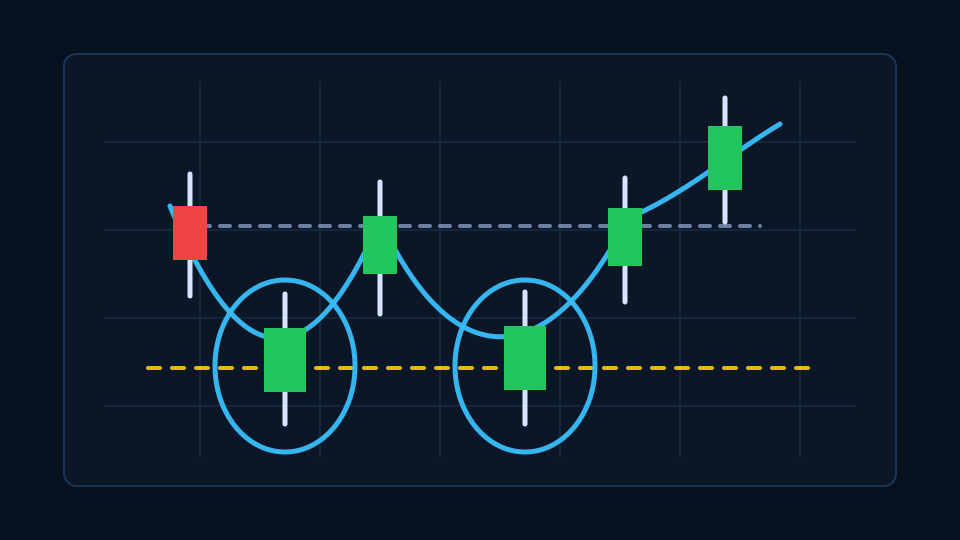
A double bottom forms when price tests a similar support area twice and the second test holds or reclaims. It can show that sellers failed to push through the same area again.
The useful read is whether support actually held, whether price reclaimed a meaningful area, and whether volume and structure improved after the second test.
What It Is
A double bottom is a repeated-support pattern.
- First test into support.
- Bounce from the first test.
- Second test near the same support area.
- Neckline or resistance area above.
- Reclaim, rejection, or failed reclaim after the second test.
Two similar lows are not enough. The pattern needs context after the second test.
Pattern Structure
The first low marks the area being tested. The bounce creates a reference level above. The second low tests whether sellers can push through the support area again.
A cleaner double bottom usually has a visible support zone, a second test that does not collapse through the first low, and a reclaim or higher-low structure afterward.
Clean Vs Forced Versions
A clean double bottom has two clear support tests and a meaningful reaction after the second test.
A forced version appears when the second low only looks similar because the chart is zoomed in too tightly. It can also be forced when the bounce between lows is weak and there is no reclaim, no higher low, and no volume shift.
Context That Matters
Double bottoms need support and reclaim context.
- Quality of the support area.
- Strength of the bounce between lows.
- Volume on each support test.
- Whether the neckline or reclaim area matters.
- Broader trend before the pattern.
- Distance from support to the next resistance area.
When It Can Mislead
Double bottoms mislead when traders call the pattern before price reacts after the second low. Support can break later, and a weak bounce can turn into a wider downtrend.
Example Chart Read
A stock sells into low of day, bounces, then revisits the same support zone. The second test holds with less selling pressure, and price reclaims the midpoint of the prior bounce. The next read is whether that reclaim holds or fails.
Common Mistakes
One common mistake is calling the pattern as soon as price touches the prior low.
Another mistake is ignoring the neckline or reclaim area.
Traders also make mistakes when they enter far above support after the move is extended.
Another mistake is missing a second-low failure that turns into a breakdown.
A final mistake is ignoring volume and market context.
Related Lessons
Key Takeaway
A double bottom is repeated support plus reaction context. The important review is whether the second test held, reclaimed, or failed.
FAQ
What is a double bottom?
A double bottom forms when price tests a similar support area twice and then reacts from that area.
What makes it cleaner?
Clear support, a meaningful bounce between tests, better reaction after the second test, and volume context.
Why can it fail?
It can fail when support breaks, the reclaim does not hold, volume fades, or the pattern is forced onto weak price action.
Is the second low enough by itself?
No. The reaction after the second low matters.