
Track your progress
To save this lesson to your Academy progress, join the free TradersLink Discord and log in with your Discord account.
Log in with DiscordPrice Rejection: How Traders Read Failed Pushes At Key Areas
Price rejection happens when price pushes into an area, fails to hold there, and moves back away from it.
It often shows up as a wick, a failed breakout candle, or a move above a level that quickly falls back under it. Rejection can happen at resistance, support, high of day, premarket levels, previous day levels, VWAP, or any other area traders are watching.
The important part is not the wick by itself.
The important part is where the rejection happened and what price did after it.
A long wick in the middle of a messy range may not mean much. A long wick into a clear resistance area after an extended push may matter more. The same candle can tell a different story depending on location.
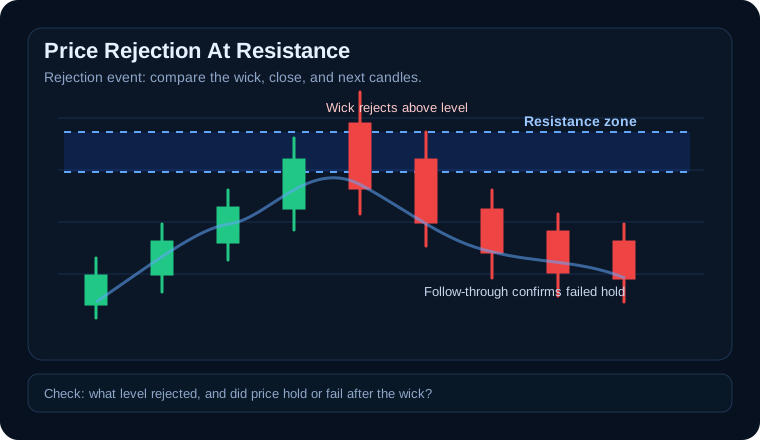
What Price Rejection Shows
Price rejection shows that price tested an area and could not stay there.
At resistance, rejection may show that buyers pushed price higher but could not hold it above the level.
At support, rejection may show that sellers pushed price lower but could not keep it below the level.
That is why rejection can appear in both directions.
A rejection near resistance may look like price pushing above a level, then closing back under it.
A rejection below support may look like price breaking under a level, then reclaiming it quickly.
The common idea is the same: price tested an area and was pushed back.
A Wick Is Not Always Rejection
Many beginners see a wick and immediately call it rejection.
That is not always right.
A wick can form because price moved into an area and failed. But it can also form because of a wide spread, thin liquidity, one fast print, or normal candle noise.
A wick becomes more useful when it has context:
- It forms at a meaningful level.
- Price fails to hold beyond that level.
- The next candles respect the failed area.
- Volume or speed supports the reaction.
- The wick changes how the chart should be read.
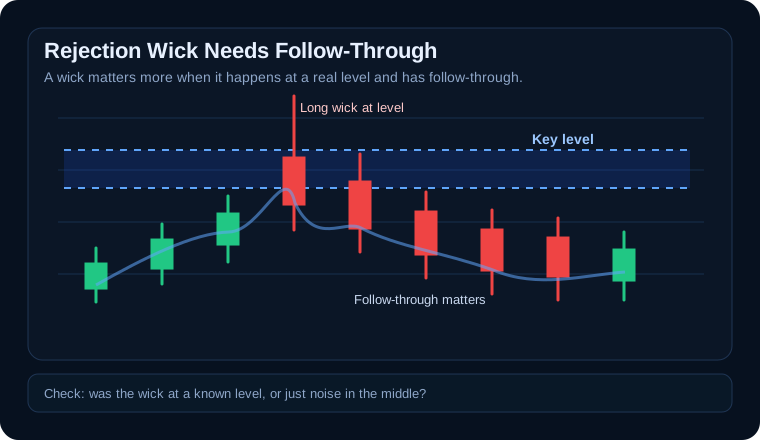
The wick gets attention. The level and follow-through decide whether it matters.
Rejection At Resistance
Resistance rejection happens when price pushes into or above resistance and cannot hold there.
For example, a stock may trade under $5.00 for most of the morning. It finally breaks to $5.08, but then quickly falls back to $4.92 and closes below the level.
That move can be read as rejection at resistance.
The better questions are:
- Was $5.00 a clear level before the move?
- Did price break above it and fail quickly?
- Did the candle close back below the zone?
- Did volume fade after the push?
- Did price later reclaim the same level or keep rejecting from it?
Resistance rejection is often connected to failed breakout behavior. Price tried to move through a level, but the hold did not happen.
Rejection Below Support
Rejection can also happen below support.
This is important because many traders only think of rejection as something that happens at resistance. But price can also reject lower prices.
For example, a stock may break below support at $3.00, trade to $2.92, then quickly reclaim $3.00 and hold above it. That can show that sellers failed to keep price below support.
The better questions are:
- Was $3.00 a clear support area before the break?
- Was the move below support brief or sustained?
- Did price reclaim the level quickly?
- Did it hold above the reclaim area?
- Did volume improve during the reclaim?
This kind of rejection can connect to reclaim lessons later in the course.
Clean Rejection Versus Random Noise
Clean rejection usually has a clear location and a clear reaction.
A clean resistance rejection might show:
- Price pushing into a known resistance area
- A wick or failed candle above the level
- A close back below the area
- Weak follow-through after the push
- Price respecting the rejected zone afterward
Random noise usually looks different.
It may show:
- A wick in the middle of a range
- No important level nearby
- Low volume or wide spread
- No follow-through after the candle
- Price ignoring the wick immediately afterward
The difference matters. A trader who treats every wick as rejection will see too many false stories on the chart.
Rejection And Failed Breakouts
Rejection is one of the main things traders watch after a breakout attempt.
A breakout starts when price pushes through a level. The next question is whether price can hold that area.
If price breaks above resistance but quickly falls back below it, the breakout attempt may be failing. That failed hold is often a form of rejection.
For example:
- Resistance is near $6.00.
- Price breaks to $6.12.
- Volume fades.
- Price falls back under $6.00.
- The next candles cannot reclaim the level.
That tells the trader the level was not accepted yet.
This does not mean the stock can never break that level later. It means the first attempt did not hold.
Rejection And Reclaims
Rejection also matters when price loses a level and then reclaims it.
A stock can reject lower prices the same way it can reject higher prices.
For example:
- Support is near $4.00.
- Price breaks to $3.90.
- Sellers cannot keep it down.
- Price reclaims $4.00.
- The next candles hold above the zone.
That tells the trader the breakdown attempt failed for now.
This is why rejection, failed breakouts, failed breakdowns, and reclaims are connected. They all ask the same basic question:
Did price accept the new area, or did it return back through the level?
Realistic Example
A stock is trading below resistance at $5.00.
It pushes to $5.08, prints a long upper wick, and drops back to $4.92. The candle closes below the $5.00 area.
A beginner may only see the wick. A better read includes the level:
- $5.00 was already resistance.
- Price briefly traded above it.
- It failed to hold above the level.
- The candle closed back below resistance.
- The next candles decide whether the rejection matters.
If price quickly reclaims $5.00 and holds, the rejection may become less important. If price keeps failing under $5.00, the rejection becomes part of the resistance story.
The wick starts the question. The follow-through answers it.
Day Trading Versus Swing Trading Context
Rejection can matter on any timeframe.
A day trader may watch rejection at:
- High of day
- Low of day
- Premarket high
- Premarket low
- VWAP area
- Opening range levels
- Intraday support and resistance
A swing trader may watch rejection at:
- Daily resistance
- Daily support
- Prior breakout zones
- Prior breakdown zones
- Multi-day highs and lows
- Gap areas
The timeframe changes the meaning.
A rejection wick on a one-minute chart may matter for a quick intraday trade but mean very little on the daily chart. A daily rejection candle may matter for a swing trader but may be too broad for a scalp.
Name the timeframe before giving the rejection too much weight.
What Beginners Usually Get Wrong
The biggest mistake is treating every wick as important.
A wick is only useful if it helps explain what happened at a meaningful area.
Common mistakes include:
- Calling every upper wick rejection
- Ignoring where the wick formed
- Ignoring spread and liquidity
- Treating one wick as a full reversal
- Ignoring whether price reclaimed the level later
- Entering after the rejection already changed the setup
- Seeing rejection only after the trade goes wrong
- Forgetting that rejection below support can be a failed breakdown
Rejection should make the chart clearer. If it turns every candle into a dramatic event, the trader is probably overreading it.
What To Watch After Rejection
After price rejects an area, watch what happens next.
Ask:
- Did price close back inside the prior range?
- Did price hold above or below the rejected level?
- Did volume fade after the failed push?
- Did price reclaim the level quickly?
- Did the next candles confirm the failed hold?
- Is the rejection happening at a level that mattered before?
- Is the move still near support, resistance, or another key area?
The next candles matter because rejection is not just the wick. It is the failed hold plus the behavior that follows.
How This Helps When Studying Charts Or Trades
Price rejection helps traders study whether a move was accepted or refused at a level.
When looking back at a chart or completed trade, ask:
- What level was being tested?
- Was the rejection visible in real time or only obvious afterward?
- Did price fail above resistance or below support?
- Did the next candles respect the rejected area?
- Did price later reclaim the level?
- Did the decision happen before or after the rejection was clear?
This keeps rejection practical. The point is not to label every wick. The point is to understand when price tried to move into an area and could not stay there.
Key Takeaway
Price rejection means price tested an area and failed to hold there.
A wick can be part of rejection, but the wick is not enough by itself. The level, the close, the next candles, volume, spread, and timeframe all matter.
Do not read every wick as rejection. Read the failed hold.
Related Lessons
- Resistance Levels
- Support Levels
- Key Levels Trading
- Level Breakout
- Level Reclaim
- Bottoming Tail Candle
- Topping Tail Candle
FAQ
What is price rejection?
Price rejection happens when price tests an area, fails to hold there, and moves back away from it.
Is every wick price rejection?
No. A wick becomes more useful when it forms at a meaningful level and price behavior afterward supports the failed-hold read.
Can rejection happen below support?
Yes. Price can break below support, fail to stay there, and reclaim the level. That is rejection of lower prices.
What is rejection at resistance?
Resistance rejection happens when price pushes into or above resistance but fails to hold above the area.
How does rejection connect to breakouts?
A failed breakout often includes rejection. Price breaks above a level, cannot hold it, and falls back below the breakout area.
What should beginners watch after rejection?
Beginners should watch whether price respects the rejected level, reclaims it, ignores it, or continues moving away from it.