
Track your progress
To save this lesson to your Academy progress, join the free TradersLink Discord and log in with your Discord account.
Log in with DiscordLevel Reclaim: How Traders Read Price Winning Back A Key Area
A level reclaim happens when price loses an important level, then moves back above it.
That level might be support, resistance, premarket high, previous day high, high of day, VWAP, a range level, or a prior breakout area.
The key idea is simple:
Price lost an area that mattered, then won it back.
A reclaim can change the way the chart is read because the first breakdown or loss of the level did not fully hold. But the reclaim still needs to prove itself. A quick move back above a level is different from a reclaim that holds, retests, and builds.
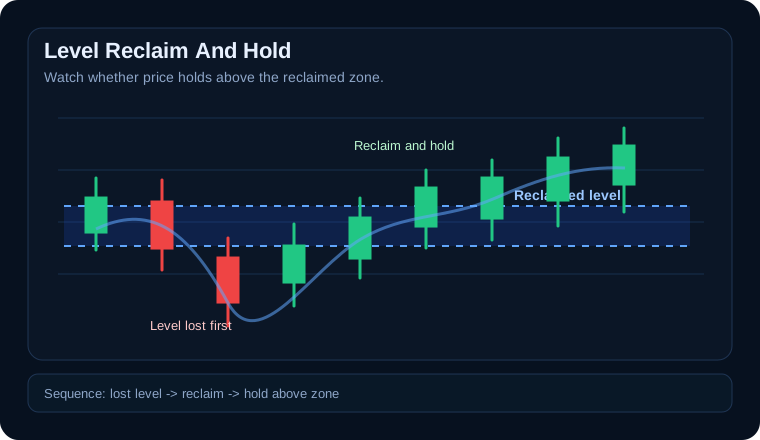
What A Level Reclaim Is
A level reclaim has two required parts.
First, price must lose the level.
Second, price must move back above it.
Without the first part, it is not really a reclaim. It may be a breakout, a bounce, or just normal movement above a level.
Common reclaim levels include:
- Support that broke and then recovered
- Resistance that price cleared, lost, and won back
- Premarket high
- Previous day high
- High of day
- VWAP area
- Range high or range low
- A broken swing level
- A prior breakout level
The level matters most when it was clear before the reclaim. If the level only becomes obvious after the bounce, the read is less useful.
How A Reclaim Is Different From A Breakout
A breakout usually means price is moving above a level into a new area.
A reclaim means price is winning back a level it already lost.
That difference matters.
For a breakout, the question is:
Can price clear this level and hold above it?
For a reclaim, the question is:
Can price recover this lost level and stay back above it?
A reclaim often happens after a failed breakdown, failed flush, failed pullback, or failed loss of a key area. It can show that sellers pushed price below a level but could not keep control there.
The Reclaim Sequence
A cleaner reclaim usually has a sequence:
- Price is trading around an important level.
- Price loses that level.
- Price trades below it for some amount of time.
- Price pushes back above the level.
- Price holds above the reclaimed area or fails again.
The fifth step is where the lesson becomes useful.
A reclaim that holds can change the chart. A reclaim that immediately fails may only be another temporary push.
Reclaim And Hold
A cleaner reclaim happens when price moves back above the lost level and holds above it.
Sometimes price retests the level from above. Sometimes it bases above the level. Sometimes it moves higher without a clean retest.
A reclaim-and-hold may show:
- The level was clear before the move.
- Price lost the level first.
- Price recovered the level with real participation.
- Price stayed above the level after reclaiming it.
- A clear failure area still exists below the reclaim.
This gives the chart a cleaner read. The level is no longer just something price lost. It becomes an area price is trying to defend again.
Reclaim Failure
A reclaim failure happens when price moves back above the lost level but cannot stay there.
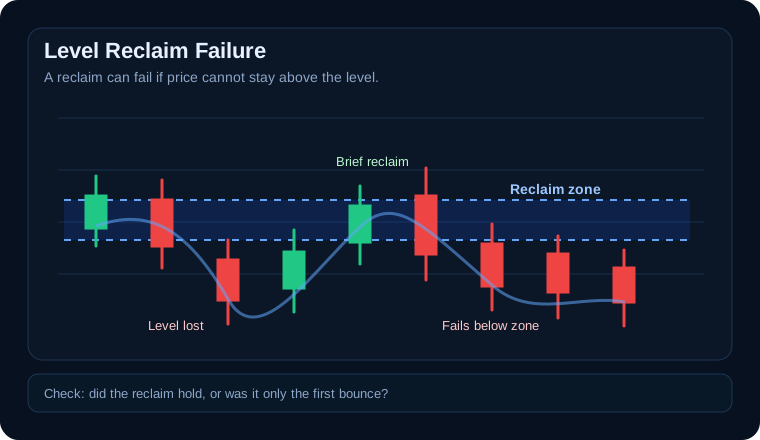
This is common. Price can reclaim a level for one candle, one wick, or one fast push and then fall back below it.
A failed reclaim may show:
- Price pops back above the level.
- Volume fades after the reclaim.
- Price cannot hold above the area.
- Nearby resistance blocks the move.
- The next candles fall back below the level.
A failed reclaim is important because it shows the level was not won back cleanly.
The mistake beginners make is treating the first move above the level as enough. The reclaim has to hold long enough to matter.
Why Reclaims Matter
Reclaims matter because they show a shift after weakness.
If price loses a level and stays below it, the chart may remain weak. If price loses the level and then wins it back, the chart needs a fresh read.
For example:
- Price loses premarket high.
- It flushes below the level.
- Sellers cannot keep it down.
- Price reclaims premarket high.
- The next candles hold above it.
That sequence is different from a clean breakdown. It shows that the loss of the level failed for now.
This is why reclaims connect to failed breakdowns, price rejection, and break of structure later in the course.
A Reclaim Needs A Real Level
Not every bounce is a reclaim.
A reclaim needs a level that mattered before price recovered it.
A strong reclaim read usually starts with a clear level:
- A level the trader had already marked
- A level price reacted to earlier
- A session level other traders may watch
- A prior support or resistance area
- A level that affected the chart before the reclaim
If a trader labels a random bounce as a reclaim after the fact, the lesson becomes less useful. The level should exist before the story is built around it.
Realistic Example
A stock opens above premarket high at $4.20.
After the open, price drops below $4.20 and trades down to $4.05. A few minutes later, price pushes back above $4.20 with stronger volume and holds between $4.22 and $4.30.
That can be read as a reclaim of premarket high.
A cleaner reclaim read might include:
- $4.20 was marked before the move.
- Price clearly lost the level first.
- Price recovered the level with stronger volume.
- The next candles held above $4.20.
- The trader could define what failure would look like.
A weaker reclaim read might include:
- The level was only noticed after price bounced.
- Price only wicked above $4.20.
- Volume faded after the reclaim.
- Price immediately fell back below the level.
- Nearby resistance blocked the move.
Both examples include price moving back above $4.20. Only one has a cleaner reclaim story.
Reclaim Versus Fake Strength
A reclaim can look exciting because price is winning back a level.
But fake strength can look similar at first.
Fake strength may show:
- A quick pop above the level
- No real hold after the reclaim
- Weak volume after the move
- Immediate rejection from nearby resistance
- Price falling back below the level quickly
A cleaner reclaim should show more than a quick cross. It should show that price is trying to stay above the area it recovered.
The difference between reclaim and fake strength usually appears after the first reclaim candle.
Day Trading Versus Swing Trading Context
Reclaims can happen on intraday charts and higher timeframes.
A day trader may watch reclaims of:
- VWAP
- Premarket high
- High of day
- Previous day high
- Opening range level
- Intraday support or resistance
A swing trader may watch reclaims of:
- Daily support
- Daily resistance
- Prior breakout zones
- Multi-day range levels
- Gap levels
- Moving average areas if part of their process
The idea is the same: price lost an important area and then won it back.
The timeframe changes the meaning. A five-minute reclaim may matter for an intraday trade. A daily reclaim may matter for a multi-day trade.
What Beginners Usually Get Wrong
The biggest mistake is thinking any move back above a level is a clean reclaim.
It is not.
Common mistakes include:
- Calling a random bounce a reclaim
- Ignoring whether the level mattered before the move
- Treating one wick above the level as a clean reclaim
- Entering after the reclaim candle is already extended
- Ignoring nearby resistance above the reclaim
- Holding after price loses the reclaimed level again
- Forgetting that the broader structure may still be weak
- Not defining what a failed reclaim looks like
A reclaim should make the chart clearer. If the level, hold, and failure area are unclear, the setup may be too messy.
What To Watch After A Reclaim
After price reclaims a level, watch whether it can keep the level.
Ask:
- Was the level meaningful before the reclaim?
- Did price actually lose the level first?
- Did price reclaim with volume or speed?
- Did price hold above the reclaimed area?
- Did price retest the level from above?
- Did nearby resistance block the move?
- What would make the reclaim fail?
- Is the reclaim happening on the timeframe that matters?
The reclaim is not just the cross back above the level. The useful information comes from what price does after winning it back.
How This Helps When Studying Charts Or Trades
Reclaim lessons help traders study whether a move repaired a lost level or only bounced briefly.
When looking back at a chart or completed trade, ask:
- What level was lost?
- Was that level marked before the move?
- How did price behave below the level?
- Did price reclaim and hold?
- Did the reclaim fail quickly?
- Was the decision made near the reclaimed level or after the move was extended?
- Did the trader adjust if price lost the reclaimed level again?
This keeps the lesson practical. The goal is not to call every bounce a reclaim. The goal is to understand when price wins back an area that mattered.
Key Takeaway
A level reclaim happens when price loses an important area, then wins it back.
The reclaim only becomes useful if the level mattered before the move and price can show some ability to hold above it afterward.
Do not stop at the reclaim candle. Watch whether price keeps the level.
Related Lessons
FAQ
What is a level reclaim?
A level reclaim happens when price loses an important level, then moves back above it.
How is a reclaim different from a breakout?
A breakout moves above a level into a new area. A reclaim wins back a level that price had already lost.
What makes a reclaim cleaner?
A cleaner reclaim usually has a meaningful level, a clear loss of that level, a move back above it, and price holding above the reclaimed area.
What is a failed reclaim?
A failed reclaim happens when price moves back above a lost level but cannot stay above it and falls below the level again.
Can reclaims happen intraday?
Yes. Traders often watch intraday reclaims of VWAP, high of day, premarket high, previous day high, support, resistance, or other key levels.
What should beginners watch after a reclaim?
Beginners should watch whether price holds the reclaimed level, retests it, fails again, or runs into nearby resistance.