
Track your progress
To save this lesson to your Academy progress, join the free TradersLink Discord and log in with your Discord account.
Log in with DiscordRising Wedge
Best suited for: day trading and swing trading.
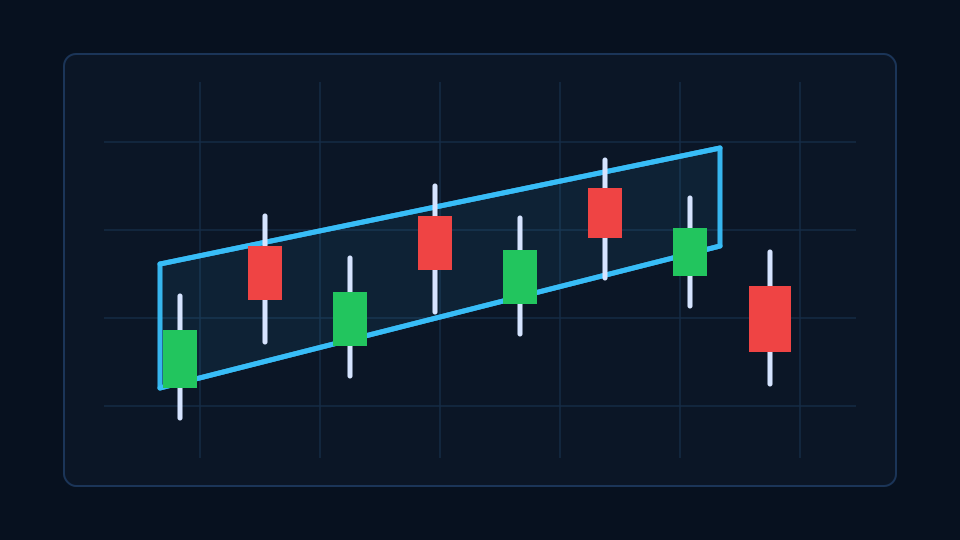
A rising wedge forms when price keeps making higher highs and higher lows, but the range narrows as it moves up. The narrowing shape can show upward progress getting weaker.
The pattern matters most when price is extended and the lower boundary becomes the area traders watch for loss of structure.
What It Is
A rising wedge forms when price moves upward inside a narrowing structure.
- Higher highs and higher lows inside compression.
- Converging upward boundaries.
- Often slower momentum near the top.
- Possible downside break or failed break.
- Need for level and volume review.
Review the higher highs, higher lows, narrowing range, and the lower boundary price would need to lose.
Pattern Structure
The pattern can show weakening progress. The next review is whether price loses structure or keeps grinding higher.
- Higher highs and higher lows inside compression.
- Converging upward boundaries.
- Often slower momentum near the top.
- Possible downside break or failed break.
- Need for level and volume review.
Context That Matters
Rising wedges need visible compression and a clear boundary. Without that, the pattern can become a forced bearish label on a chart that is simply trending higher.
- Support and resistance quality.
- Trend before the pattern.
- Volume during formation and attempted break.
- Distance from invalidation.
- Liquidity, spread, and slippage.
- Catalyst, filing, or market context where relevant.
When It Can Mislead
Rising wedges mislead when traders call a top before price confirms anything.
Example Chart Read
A stock keeps making higher highs, but each push becomes smaller and volume fades. The useful read is whether a break below the wedge actually follows through.
Common Mistakes
One common mistake is seeing the pattern before it is actually formed.
Another mistake is entering late after the clean risk area has passed.
Traders also make mistakes when they ignore volume and nearby levels.
Another mistake is holding after the pattern fails.
A final mistake is using the pattern label to justify a reactive trade.
Related Lessons
Key Takeaway
A rising wedge can show tightening structure into a move, but it is not useful unless the level, volume, and failure behavior are clear.
FAQ
What is Rising Wedge?
A rising wedge forms when price moves upward inside a narrowing structure.
What weakens a rising wedge?
It weakens if price keeps holding the lower boundary and expands higher with clean strength.
What context matters most?
Levels, trend, volume, liquidity, risk, and follow-through matter most.
Why do these trades fail?
They often fail because entries are late, volume fades, a key level fails, or the pattern was forced.
How should it be reviewed?
Review pattern quality, entry timing, volume, level behavior, invalidation, and whether the plan was followed.
What should this pattern be compared with?
Compare it with trend extension, compression quality, volume, and whether price actually loses the lower boundary.