
Track your progress
To save this lesson to your Academy progress, join the free TradersLink Discord and log in with your Discord account.
Log in with DiscordKey Levels Trading: How To Build A Clean Level Map
Key levels are the price areas that give a chart its shape.
They are the places where price has already reacted, paused, reversed, accelerated, or changed character. A key level might be a support zone, resistance zone, previous day high, premarket low, high of day, low of day, swing high, swing low, gap area, breakout level, breakdown level, or reclaim area.
Key levels trading is the habit of organizing those areas into a usable map before studying a setup or reviewing a trade.
The map does not need to predict what comes next. Its job is simpler and more useful: show where price is, where nearby pressure may appear, and which areas matter most right now.
What Key Levels Are
A key level is a price area that has meaning on the chart.
That meaning can come from a prior reaction. Price may have bounced from the area, rejected from it, held it several times, or failed there after a breakout attempt.
Meaning can also come from session structure. Premarket highs, previous day highs, previous day lows, high of day, and low of day often attract attention because many traders can see them.
Common key levels include:
- Support areas
- Resistance areas
- Previous day high and low
- Premarket high and low
- High of day and low of day
- Swing highs and swing lows
- Range highs and range lows
- Breakout and breakdown areas
- Gap zones
- Reclaim levels
- Higher timeframe reaction zones
The important word is area. A level is rarely a perfect one-cent line. Most useful levels are zones where price behavior changes.
Why Traders Use A Level Map
A level map helps a trader read location.
Without a map, every candle can feel urgent. A green candle looks strong. A red candle looks weak. A fast move can make the trader react before understanding where the move is happening.
With a clean map, the trader can ask better questions:
- Is price near support, resistance, or the middle of a range?
- Is the trade moving into a nearby problem area?
- Is there room before the next important level?
- Which level would change the read if price loses it?
- Which level should be studied after the trade?
A level map turns the chart from a stream of candles into a set of important locations.
That matters most when price is moving quickly. The trader may still need to make a fast decision, but the decision is anchored to chart structure instead of emotion.
Clean Map Versus Cluttered Map
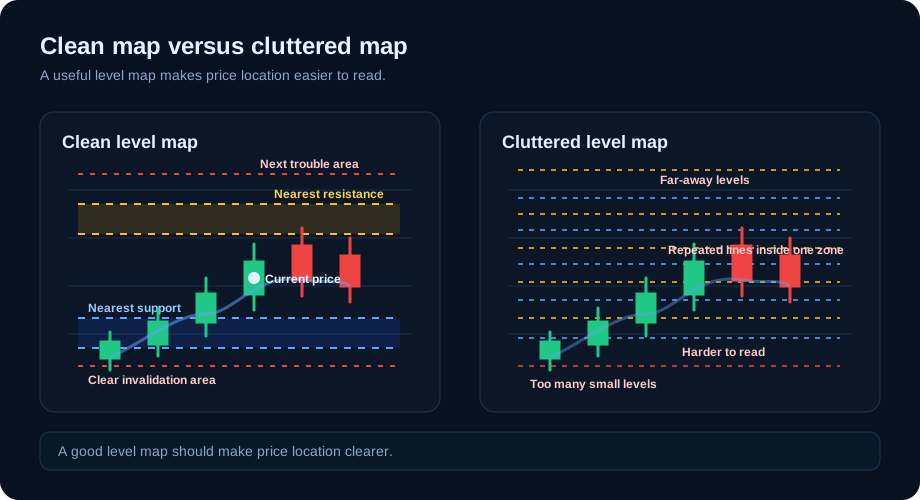
A clean level map shows the levels that matter now.
A cluttered map shows every price where something happened once.
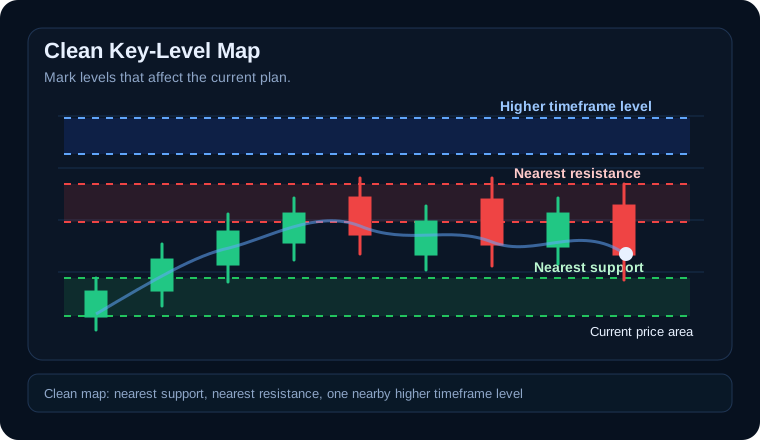
On a clean map, the trader can quickly see:
- The nearest support below price
- The nearest resistance above price
- The next higher timeframe level nearby
- The level that would make the current idea weaker
- The level that would create the next review question
On a cluttered map, every candle has a line above it and below it. That can make the chart feel more precise, but it usually makes the read worse. If every level matters, no level really stands out.
A good rule is to ask: "Will this level affect the next decision or the next review?"
If the answer is no, it may belong in notes instead of on the active chart.
Higher Timeframe Levels
Higher timeframe levels often deserve a place on the map because more traders can see them.
For a day trader, that may include:
- Previous day high
- Previous day low
- Daily chart resistance
- Daily chart support
- A major multi-day high or low
- A recent gap area
For a swing trader, higher timeframe levels are even more important. A swing trade may depend on daily chart structure, weekly chart ranges, multi-day support, or a larger resistance area that is not obvious on a one-minute chart.
Higher timeframe levels do not override the current chart. They give the current chart context.
For example, an intraday breakout may look strong on a five-minute chart. If that breakout is happening directly into daily resistance, the trader should know that before reviewing the setup. The level does not decide the trade by itself, but it changes the location read.
Nearest Active Levels
After marking the larger areas, the next job is to find the nearest active levels.
The nearest active levels are the levels most likely to matter to the next chart decision.
They usually include:
- Nearest support below current price
- Nearest resistance above current price
- The current range high or range low
- The level price just broke from
- The level price just failed to hold
- The level that would make the current read change
These nearby levels keep the map practical.
A stock may have ten meaningful levels on a daily chart. That does not mean all ten belong on the active intraday map. If price is trading at $5.80, the nearby $5.50 support and $6.00 resistance may matter more than an old $8.25 level that is far from today's action.
What Each Level Means
A key level should have a job.
If a trader marks a line and cannot explain why it matters, the line may only add noise.
Useful level labels might sound like:
- "Nearest resistance from the premarket high"
- "Support from the last pullback low"
- "Previous day high and possible trouble area"
- "Range low where the chart weakens if lost"
- "Breakout level to study if price holds above it"
- "Former support that may matter from below"
This does not need to become complicated. The goal is to know what the level means before price gets there.
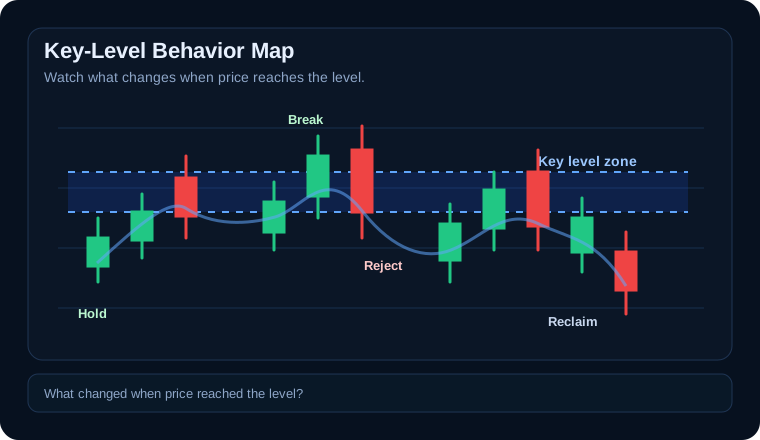
When a level has a clear job, the trader can study the reaction more honestly. Did price hold? Did it reject? Did it break and fail? Did it reclaim? Did the trader respect the map or ignore it?
A Realistic Example
Imagine a stock is trading at $5.80 after a strong morning move.
The chart shows:
- Premarket high near $6.00
- Previous day high near $6.15
- Intraday support near $5.45
- A small pullback low near $5.62
- An old daily resistance area near $7.20
A cluttered map might mark all five levels on the active intraday chart, plus several minor candle highs and lows from the morning.
A cleaner map may focus on:
- $5.45 as the main intraday support area
- $6.00 as the nearest active resistance
- $6.15 as the higher timeframe level just above resistance
That map gives the trader enough structure to study the move.
If price pushes into $6.00 and immediately rejects, the trader can review whether the entry chased into resistance. If price breaks $6.00 but cannot hold above it, the trader can study the failed breakout. If price pulls back toward $5.45, the trader can watch whether the main intraday support area still matters.
The old $7.20 level may still be useful background, but it is not the next decision area. Keeping it off the active map can make the chart easier to read.
What Makes A Level More Important
Some levels matter more than others.
A level usually becomes more important when several forms of context overlap.
Examples:
- A prior resistance area lines up with the premarket high.
- A previous day high sits just above current intraday resistance.
- A support area has held multiple times.
- A range low also matches a higher timeframe support zone.
- A breakout level later becomes the area price returns to test.
- A level has strong volume or repeated reactions around it.
Clarity matters too. A messy level that only makes sense after drawing five extra lines may be less useful than a simple range high every trader can see.
The best levels tend to be visible before the move, close enough to matter, and connected to a real chart reaction.
Day Trading Versus Swing Trading Context
Day traders and swing traders can use the same level-map idea, but the map should fit the timeframe.
For day trading, the active map often focuses on:
- Premarket high and low
- Previous day high and low
- High of day and low of day
- Intraday support and resistance
- Breakout, breakdown, and reclaim areas from the current session
The day trader is usually asking: "Where is price now, and what level affects the next intraday decision?"
For swing trading, the map often focuses on:
- Daily support and resistance
- Multi-day range highs and lows
- Larger swing highs and swing lows
- Gap areas
- Major breakdown or reclaim levels
- Weekly chart context when relevant
The swing trader is usually asking: "Where is this trade idea within the larger structure?"
The mistake is mixing the two without thinking. A day trade can become cluttered if the chart is covered with distant swing levels. A swing trade can become sloppy if the trader ignores major daily resistance because the intraday chart looks strong.
Beginner Mistakes
Beginners often struggle with key levels because they try to make the chart certain.
The better goal is to make the chart readable.
Common mistakes include:
- Marking too many levels
- Treating every tiny candle high as resistance
- Treating every tiny candle low as support
- Ignoring the nearest obvious level
- Drawing levels after the move and pretending they were planned
- Keeping far-away levels on the active map
- Forgetting higher timeframe context
- Treating all levels as equally important
- Moving a level to justify a trade
- Reviewing only profit or loss instead of location quality
A beginner-friendly map should be simple enough to explain out loud.
If the explanation takes too long, the map may need fewer lines.
What To Watch As Price Moves Through The Map
A level map becomes useful when price starts interacting with it.
As price moves, watch how it behaves near the important areas:
- Does price slow down before resistance?
- Does volume expand or fade into the level?
- Does support hold cleanly or get tested again and again?
- Does price break a level and hold above it?
- Does price break a level and immediately fail?
- Does old support become resistance?
- Does old resistance become support?
- Does the trader's entry happen near the planned area or far away from it?
These reactions create better review material.
The question is not only whether the trade won or lost. The better question is whether the decision made sense at that location on the map.
How This Helps When Studying Charts Or Trades
Key levels make chart study more specific.
Instead of saying, "The stock went up and then failed," a trader can say, "Price pushed into the premarket high, failed to hold above it, and then lost the prior pullback low."
Instead of saying, "I entered too late," a trader can say, "I entered after price had already moved from support into nearby resistance."
That kind of review is more useful because it points to behavior the trader can study again.
A level map can help review:
- Whether the trade was taken near a planned area
- Whether the trader chased into resistance
- Whether support failure was respected
- Whether a breakout held or failed
- Whether the trader ignored a nearby higher timeframe level
- Whether the chart was too cluttered to read clearly
The map gives language to the trade. That language makes the review easier to repeat.
Key Takeaway
Key levels trading is about building a clean map of the price areas that matter most.
A strong level map does not need many lines. It needs the right lines: higher timeframe context, nearest active support and resistance, and the levels that explain what changes if price holds, breaks, rejects, or reclaims.
The cleaner the map, the easier it is to study the chart and review the trade honestly.
FAQ
What are key levels in trading?
Key levels are important price areas where price has reacted before or where many traders may be watching, such as support, resistance, previous day highs, premarket lows, swing highs, swing lows, and gap areas.
What is a level map?
A level map is a clean set of important price areas marked on a chart. It helps a trader understand where price is, what level is nearby, and what reaction should be studied next.
How many key levels should I mark?
Mark the levels that matter to the current chart read. For many active charts, that means nearest support, nearest resistance, one or two higher timeframe areas, and the level that would change the current idea.
Are higher timeframe levels important for day trading?
Yes, they can be. A day trader may still need to know where the previous day high, previous day low, daily resistance, or daily support sits because those areas can affect intraday reactions.
What makes a key level stronger?
A level is usually more important when it is visible before the move, has clear prior reactions, lines up with another meaningful level, sits near current price, or connects directly to the trade being studied.
What is the biggest beginner mistake with key levels?
The biggest mistake is clutter. Too many lines make the chart harder to read and can give the trader a reason to justify almost any decision.
How do key levels help with trade review?
They help the trader review location. The trader can study whether the entry, exit, hold, chase, or hesitation happened near support, resistance, a breakout level, a failed level, or the middle of unclear structure.